Accounts Receivable Best Practices: 8 Habits of World-Class Collections Teams
Quick Summary
- Great collectors work the account, not the invoice. The decision is made fresh from the whole picture, and re-made whenever anything changes
- Finding the right person is half the job, and it's the half that gets abandoned first when volume rises
- Collections is multiplayer. The CSM and account manager hold standing the AR team doesn't, and the seam between them should be invisible to the customer
- Disputes get owned, not just removed from the cadence. A same-day holding reply matters as much as the resolution
- Messages come from a named person, on the existing thread. This moves response rates more than any cadence tuning
- Records are always live, because the next action should reflect what is true today rather than last week
This is the standard. Almost nobody sustains it past a few dozen accounts, which is a separate problem covered in Chapter 6.
What the standard actually is
Most collections content describes a process. Very little describes the craft, which is the part that separates a team collecting 70% of what it could from one collecting 90%.
The difference is rarely the cadence. Two teams can run identical schedules and get results that are nothing alike.
What follows is what excellent looks like when someone has mastered the craft. It's demanding, and it's worth reading as a standard rather than a checklist, with every account treated like your single most important one.
1. Work the account, not the invoice
A great collector doesn't think "invoice 4471 is at day 30." They think about this customer, right now:
- Who they are
- What they have paid historically
- What is currently in dispute
- Who actually authorizes payment
- What their AP run looks like this month
- Whether a colleague has a renewal in flight
Every move gets decided from that whole picture, and re-decided the moment anything in it changes.
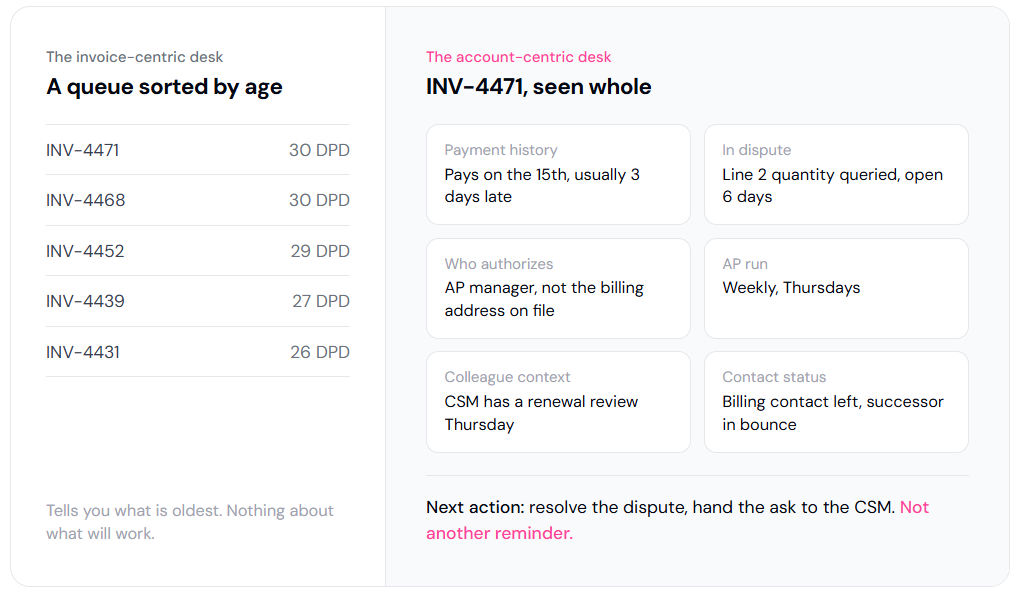
The invoice-centric alternative feels efficient and produces worse outcomes. A queue sorted by days past due tells you what is oldest. It tells you nothing about what will actually work on any given account.
The tell is what happens when something changes. On an invoice-centric desk, the cadence carries on. On an account-centric desk, new information changes the next action.
2. Find the right person, even when they're hidden
The billing contact left eight months ago, or the AP function moved to a shared service center in another country. The email bounces, or worse, it doesn't bounce and nobody reads it.
This is where most collections fail silently. An account with a dead contact looks identical in your aging report to an account that's ignoring you.
A good collector doesn't email the void and mark it as attempted. They work through the routes in order:
- Start with what you already own. The ERP has an AP address, the CRM has the buyer who signed, the payment provider has whoever made the last payment, and last quarter's email thread has the controller who actually replied
- Read the bounce properly. A hard bounce naming a successor, an out-of-office naming a colleague, or an autoreply pointing at a shared inbox are all free intelligence
- Go to the company's own structure. LinkedIn for the current AP or credit manager, the main switchboard for a transfer, the customer's supplier portal for a contact of record
- Ask internally before you ask externally. Your rep or CSM often has a warm route into the customer's finance team and can make an introduction in one message
Finding the right human is half the job. It's also the half that disappears first when the account count rises, because it's slow, manual, and invisible on any dashboard.
An account isn't unreachable until you have actually tried to reach it.
3. Bring your colleagues in before you escalate
The colleagues who own the relationship hold context and standing the AR team doesn't have.
World-class collections runs with them rather than alongside them. You check before you escalate, and you hand a delicate ask to the CSM to raise in their next business review. You stand down the moment an account manager steps into a thread, and you get warm-introduced to the customer's finance team instead of cold-emailing it.
Done well, the customer never sees the seam. They experience one company that happens to be organized internally, rather than two departments with different opinions about them.
Done badly, AR sends a restriction warning the day before a renewal conversation.
Chapter 2 covers how to run that coordination in practice.
4. Meet the customer's AP machinery on its terms
VIP treatment means paying attention to how the payer actually pays.
That means uploading the invoice to the portal they mandate, in the format they require, with a PO that will survive a three-way match. It also means timing the chase to land just before their weekly payment run rather than the day after it.
The best collectors come to know the customer's AP process the way a good hand knows the land, better than the people who own it. They know which entity to bill and who approves above a given threshold.
That knowledge is the difference between an invoice that clears on time and one that sits parked with nobody assigned to it.
There's a mindset attached. When an invoice fails to process because it went in wrong, a great collector treats that as their problem to fix rather than the customer's fault to be chased for.
5. Pull disputes out instantly and own them
Chapter 2 covers the mechanics of disputes and deductions. The craft is in the execution.
The moment a query surfaces, the invoice leaves the cadence. That much is process.
What distinguishes an excellent collector is everything after:
- A holding reply the same day, before the answer exists, so the customer never wonders whether anyone heard them
- Chasing the internal owner harder than the customer would. The person who can resolve it usually has other priorities, and the dispute moves at the speed of whoever is pushing it
- Closing the loop personally, rather than letting the customer discover the resolution when the next statement arrives
Doing disputes brilliantly is often what saves the relationship. A customer who raises a problem and watches it get handled well ends up more confident in you than one who never had a problem at all.
6. Write like a person, from a real inbox
Write bespoke messages that reference the actual account and its history, sent as yourself from a monitored address, on the thread that already exists, rather than as a templated notice from no-reply.
The customer feels that a person is looking after their account, because one is. This single thing moves response rates more than any amount of cadence tuning.
The mechanics are unglamorous and they matter:
- Reply on the existing thread so the history sits underneath and the customer has context without hunting for it
- Reference something specific and true. The PO number they use, the portal they mandate, the fact they usually pay on the 15th
- Sign as a person whose replies reach an inbox someone reads
- Vary the message because an account that receives four identical paragraphs learns that nobody is reading their replies either
None of this is difficult on one account. All of it is impossible by hand across a thousand, which is exactly why it's the first thing sacrificed.
See how Lunos solves this
Personal messages from a real inbox, on the existing thread, referencing what's actually true on the account. That's exactly what the Lunos collections agent writes, on every account, at any volume.
7. Keep records that are always live
Every promise pinned to an amount, a date, and a method. Every dispute logged. Every contact update captured. Every side agreement a colleague made reflected before the next action fires.
The purpose is narrow and important. The next decision should be made on what is true today, not what was true last week.
Broken records are what create false past-dues and duplicate chasing, and the failures are almost always mundane rather than dramatic. An extension agreed on a thread AR never saw, or a payment applied to the wrong invoice.
Each one produces the same result, which is a customer being chased for something that's not their fault.
The standard is that the record is live and correct at the moment the next action fires.
8. Treat every account as an individual
Dispute status, balance, risk history, strategic value, sophistication, payment cycle, promise history, relationship temperature, reason for lateness, contactability.
A great collector weighs as many of these as they can hold, on every account, every time. Chapter 4 covers the full set and how to segment when you can't hold them all.
Your best hand, on every account
Lunos works the account rather than the invoice, keeps records live, and treats every customer as an individual, whether you have fifty accounts or five thousand. Book a demo and watch it hold the standard your best collector sets.