How to Build a Collections System
Quick Summary
- Fixed day 7/14/30 cadences stop working. Customers learn the pattern, and a calendar can't tell two accounts apart
- A good cadence keeps one backbone and varies the speed and the pressure by behavior, balance, and what is actually going on
- Channel is a real decision. Email scales, the AP portal is mandatory wherever it's mandated, and the phone is a strong tool you often don't have
- Most teams have one stale email per account because contacts sit scattered across systems nobody cross-references, not because the contacts don't exist
- Segment on as many axes as you can hold. Simplifying is a bandwidth compromise, so make the cuts deliberately rather than defaulting to big versus small
- Collections doesn't end when money arrives. It ends when money is matched, and unapplied cash is what makes you chase customers who already paid
- Templates are skeletons to personalize, sent by a named person from a real address. Mail-merge from no-reply is what craters response rates
The system is the backbone. The judgment layered on top of it's what actually collects.
How to design a dunning cadence
Your dunning cadence is the sequence of reminders you run against an unpaid invoice. It sets how many touches an account gets, how far apart they land, and how the pressure changes as the invoice ages.
Almost every team builds the wrong one first.
Why fixed day-7/14/30 cadences fail
The default everyone reaches for is a fixed ladder. Reminders on day 7, day 14, and day 30, fired automatically from a no-reply address to every account alike.
The appeal is obvious enough. It takes an afternoon to configure, it runs without anyone touching it, and every invoice technically gets chased.
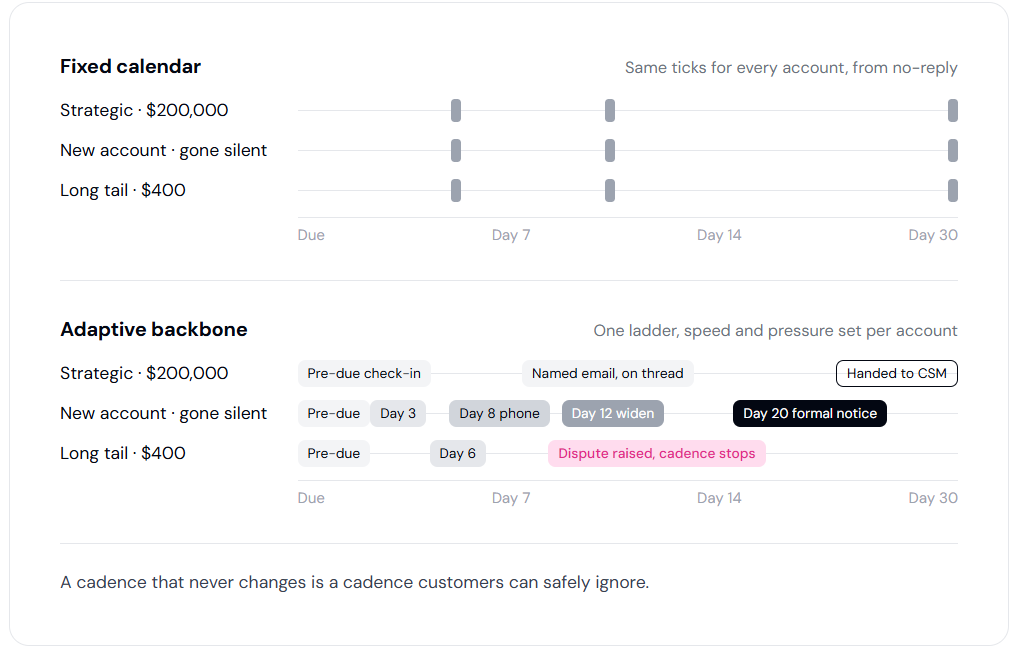
Customers learn the pattern faster than teams expect. They see a machine, notice that nothing happens when they ignore it, and tune it out. The longer the same rhythm runs, the less it lands.
The deeper problem is that a fixed calendar treats every account identically. Two customers at the same days past due can need opposite handling, and a fixed ladder can't tell them apart, so it under-serves both.
A cadence that never changes is a cadence customers can safely ignore.
What to vary from account to account
Keep one backbone for everyone. Vary the speed and the pressure per account.
Three things decide how you run it:
- How the customer behaves: their payment history, their promise-kept rate, whether they have gone quiet
- How much is at stake: the balance size, and the strategic value of the relationship
- What is actually going on: a dispute, a missing PO, a known cash crunch, a contact who left
A $200,000 strategic account and a $400 long-tail invoice should never run the same sequence, even on the same day past due.
The point is to read the account and adjust, so the cadence responds proportionally to what the customer does instead of marching on regardless.
The best time to send a payment reminder
Timing moves response rates more than most teams expect. The specifics below come from practitioner experience rather than published research, so treat them as a starting point to test against your own data.
What tends to work:
- Mid-week beats the edges. Tuesday through Thursday lands better than Monday or Friday
- Mid-morning in the recipient's timezone puts you near the top of the inbox during working hours
- Monday inboxes are a triage pile, and your message competes with the weekend backlog
- Friday afternoon gets ignored until Monday, by which point it's buried
- The month-end AP crunch is worth working around rather than into
One timing rule doesn't depend on folklore at all. If you know the customer's AP payment run, match it. Landing the day before their weekly run beats three weeks of chasing after it.
Choosing the right channel
Channel choice is a collections decision in its own right, not a detail of the escalation ladder. Each option trades scale against signal.
The discipline is to use the channels you actually have for that account, and to keep widening them.
Your default. It scales and it creates a dated paper trail, with the invoice and a payment link attached to the same message.
Most of your outreach lives here, and most of it should.
Phone
High-signal, when you have a real number for a real person. A call tells you why an invoice is unpaid, whether that's a dispute, a cash issue, or the wrong contact, faster than ten emails will.
The constraint nobody writes about is that you often don't have a usable number. Sometimes the only one on file is a reception line. Treat the phone as a strong tool you may or may not have on a given account, rather than the automatic next step after email.
AP portal
Non-negotiable wherever the customer mandates it, whether that's Ariba, Coupa, Tipalti, or something in-house.
If the invoice isn't in the portal, no amount of chasing gets you paid, because the AP team can't action it.
On those accounts, getting the invoice into the portal correctly is the collection.
Letters and SMS
These are escalation signals more than everyday tools.
A physical letter still reads as "this is now serious," which is exactly why it should be rare enough to mean something. SMS can cut through for a time-sensitive nudge, used sparingly and only where the relationship supports it.
Why fragmented data under-collects
Most teams have exactly one contact per account, and it's usually a generic AP address that may or may not be monitored.
Other contacts exist. They're scattered across systems, and nobody assembles them.
Consider where the routes into a single account actually sit:
- The ERP has an AP email, entered at onboarding and never updated since
- The CRM has the buyer who signed the contract
- The payment provider has a finance contact from the last successful payment
- Last quarter's email thread has the controller who actually replied
Held separately, that's one dead address. Assembled, it's four live routes and a full payment history on the same account.
Every contact left stranded in a system nobody cross-references is a route to payment you aren't using. It's why an account that's entirely reachable still reads as unreachable.
The same applies to your colleagues. The CSM has a champion and the rep has an economic buyer. The knowledge exists, it just isn't pooled.
Segmenting accounts
Segmentation decides who gets which treatment.
The goal is to treat every account as an individual, weighing everything you know about it. Teams simplify because a person can't hold fifteen signals across hundreds of accounts at once, not because fewer signals produce better collections.
Every axis you drop is signal sacrificed and cash left on the table.
The axes that matter
Roughly in order of impact:
- Dispute or query status, always first: a disputed invoice leaves the cadence immediately
- Balance size: how much hands-on effort the account justifies
- Risk and payment history: poor history earns tighter terms and faster escalation
- Strategic and relationship value: your biggest customers get a human and a softer touch
- Customer sophistication: enterprise AP with portals and POs is a different game from an SMB owner paying from a phone
- Where they're in their own payment cycle: reaching them just before their AP run beats three weeks of chasing after it
- Promise-kept history: a reliable late-payer isn't the same risk as a silent one
- Relationship temperature: a recent complaint, a renewal in flight, or an active upsell all change how hard you press
- Reason they're late: cash distress, a missing PO, a holiday, a contact who left, each wants a different response
- Contactability: how many good routes you actually have into the account
- Seasonality and context: their year-end, your quarter-end, a known industry crunch
- Currency, geography, and terms: the long tail of smaller signals that still move response rates
How to simplify deliberately
If you have to simplify, do it on purpose.
Pick the cuts that lose the least signal. Most teams default to "big versus small" because it's the easiest cut to make, not because balance size carries the most information.
Dispute status is almost always the higher-value cut. It changes what you do completely, where balance size only changes how much effort you spend.
The fewer axes you're forced to drop, the better the collection.
New customers and the long tail
Two account types deserve their own rule.
- New customers set the pattern with their first late payment. Establish good behavior early and firmly, or you spend the life of the account fighting the habit you allowed in month one.
- The long tail is the pile of low-value, high-volume accounts a manual team never reaches. That's real recoverable revenue sitting in aging buckets purely because nobody had the capacity to weigh it individually.
The long tail usually pays for the effort of working it when you do it consistently.
A person can't weigh fifteen signals across hundreds of accounts. The Lunos collections agent can. It reads dispute status, promise history, balance, and behavior on every account, every time, and runs the cadence each one actually needs.
Staying firm without damaging the relationship
Firm and friendly aren't opposites. The best collectors are reliably both.
Six principles hold this together:
- Separate the person from the debt. "Let's get this sorted," rather than "you owe us"
- Assume process friction before bad faith. Most late payment is a blocked invoice rather than an unwilling customer, so lead with curiosity. Chapter 1 covers why
- Make paying easy. Clear amount, working link, right contact, invoice attached. Friction reads to the customer as your fault, and it is
- Be consistent and predictable. Customers respect a known process and resent surprises. A holds policy applied evenly is firm, while the same policy applied at random is hostile
- Never let a penalty arrive unannounced. The warning is what collects, and the hold or fee is only what happens when the warning is ignored
- Protect strategic accounts on purpose. Route them to a human, run a slower cadence, soften the tone. Some relationships are worth more than the invoice
Cash application and remittance
Collections ends when the money is matched to the right invoice, which can be days after it arrives.
When cash lands without clear remittance it sits unapplied, the invoice still shows as open, and your cadence chases a customer who already paid. One rule is worth enforcing in your system rather than trusting to memory: never send a dunning message on an account carrying unapplied cash until someone has checked it.
For what breaks the match and how to handle remittance properly, see our guide to the cash application process.
Templates and how to use them
Templates exist to stop you rewriting the same message from scratch. They don't exist to be sent as-is.
Fully-templated sends from a no-reply address are the thing that kills response rates. A customer can tell the difference between a message written to them and a message merged at them, and they respond accordingly.
Three rules for using what follows:
- Personalize the specifics. Reference the actual account, the actual history, and anything you already know is blocking the invoice
- Send as a named person from a real, monitored address. Replies should reach someone
- Reply on the existing thread where one exists, rather than starting a fresh notice
Pre-due confirmation
Subject: Invoice [#] due [date]
Hi [Name],
A quick heads-up that invoice [#] for [amount] is due on [date]. I've attached it again for easy reference, along with the payment link.
If you need anything from us to get it processed, just reply here and I'll sort it out.
Thanks, [Your name]
First past-due reminder
Subject: Invoice [#] now past due
Hi [Name],
Invoice [#] for [amount] was due on [date] and is still showing as unpaid on our end. It may simply have been missed, so no worries if so.
Could you confirm the payment date, or let me know if anything is holding it up? Happy to help either way.
Thanks, [Your name]
Final notice
Subject: Final notice, invoice [#]
Hi [Name],
Invoice [#] for [amount] is now [X] days past due, despite previous reminders. We would like to resolve this with you directly.
Please arrange payment by [date], or contact me so we can agree on a plan. If we don't hear back, the account will move to our formal recovery process.
Regards, [Your name]
A short, dated paper trail like this matters if an account ever escalates. It shows you gave the customer every reasonable chance to pay.
If you want to compare tools that run cadences for you, see our roundup of dunning management software.
The backbone is easy, the judgment is the work
Lunos runs both: one system across your whole ledger, with per-account decisions a fixed calendar can't make. Book a demo to see what an adaptive cadence looks like on your accounts.