

Summarize:


Collection Effectiveness Index (CEI): How to Calculate + Improve
The Collection Effectiveness Index (CEI) is a measure of how much of the total receivables available during a period (both past-due balances and new billings) you actually collect. It tracks real collection success, not just speed. In this guide, I'll walk you through what CEI really measures, how to calculate it, and seven practical strategies to improve it.


Quick Summary
The Collection Effectiveness Index (CEI) is a measure of how much of the total receivables available during a period (both past-due balances and new billings) you actually collect. It tracks real collection success, not just speed.
In this guide, I'll walk you through what CEI really measures, how to calculate it, and seven practical strategies to improve it.
Want to Improve Your Collection Success?
The Collection Effectiveness Index (CEI) is a percentage that measures how effectively your business collects outstanding receivables over a specific period. Unlike days sales outstanding (DSO), which measures how fast you collect, CEI measures the quality of your collections process.
Think of it this way: DSO asks, "How fast are we collecting?" CEI asks, "How much of what we could collect are we actually collecting?"
Here's a simple scenario. You start the month with $100,000 in receivables. You make $50,000 in new credit sales. That's $150,000 total, which is potentially collectible. At the end of the month, you've collected $120,000. Your CEI shows what percentage of that available money you actually brought in.
Why Trust Us

At Lunos, we spent years watching finance teams struggle with the same frustrating bottleneck: accounts receivable isn't really a payment problem. It's a communication problem.
And that communication costs companies millions.
We’ve worked with finance teams handling anywhere from 500 to 50,000 invoices per month and understand what actually improves collection effectiveness in practice.
So when we talk collection success, we know what we’re talking about.
Why CEI Matters
If you want to understand whether your collections efforts are actually paying off, CEI is one of the most important metrics you can track. Unlike surface-level indicators, it shows what’s really happening behind the numbers.
- It measures actual performance, not just speed. You can have a low DSO and still be leaving significant money uncollected. CEI shows you how much of your available receivables you're actually converting to cash.
- It reveals the collection process quality. A high CEI indicates your collections process is working effectively. You're successfully following up, resolving disputes, and getting customers to pay. A low CEI indicates a problem.
- It highlights cash flow reality. CEI directly impacts cash flow by showing how much revenue actually enters your bank account versus remains in receivables limbo throughout the cash collection cycle.
- It helps benchmark team effectiveness. CEI is one of the best ways to measure your collections team's performance and identify when you need to investigate process issues.
Bottom line: CEI matters because it does more than just tell you how fast you collect. It shows how well your collections operation is performing, making it essential for improving cash flow and accountability.
How to Calculate Collection Effectiveness Index
The CEI formula looks intimidating at first, but once you understand what each component represents, it makes sense.
The Standard CEI Formula
CEI = [(Beginning AR + Credit Sales - Ending AR) ÷ (Beginning AR + Credit Sales - Ending Current AR)] × 100
- Beginning AR: Total amount that customers owed you at the start of the period.
- Credit Sales: All sales you made on credit during the period (excludes cash sales).
- Ending AR: Total amount customers owe you at the end of the period.
- Ending Current AR: The portion of ending AR that isn't yet due—invoices still within payment terms.
The numerator shows what you actually collected. The denominator shows what was realistically available to collect (you can't collect invoices that aren't due yet).
A Real-World Example
Let's use a B2B software company's quarterly data:
- Beginning AR: $150,000
- Credit sales during quarter: $200,000
- Ending total AR: $180,000
- Ending current AR (not yet due): $80,000
Amount collected: $150,000 + $200,000 - $180,000 = $170,000
Available to collect: $150,000 + $200,000 - $80,000 = $270,000
CEI: ($170,000 ÷ $270,000) × 100 = 62.96%
That translates to collecting 63% of available receivables in the quarter.
What's a "Good" CEI Score?
The figures in this section are not universal standards. Averages vary by industry, customer profile, and credit policy.
So, on average, what’s a good collection effectiveness index score?
- 85% or higher: Excellent. Your collections process is working well.
- 70-84%: Good. There's room for improvement, but collections are reasonably effective.
- Below 70%: Concerning. Indicates significant inefficiencies or serious customer payment issues.
For context, many high-performing B2B companies target 85% or above. SaaS companies with subscription models often achieve 85-95%, while manufacturing or distribution companies with longer payment cycles typically see 70-85%.
Note: One of the most effective ways to improve your CEI is to invest in the best dunning management software.
The most important comparison is against your own historical performance. If you notice a downward trend in your CEI, that's your signal to investigate, regardless of industry benchmarks.
7 Strategies to Improve Your Collection Effectiveness Index
Knowing your CEI is useful. Improving it is what actually impacts your cash flow. Here are seven strategies that work.
1. Fix Your Invoicing Accuracy and Timing
Incorrect or delayed invoices can negatively impact your CEI. For example, if a customer receives an invoice with errors, they hold payment until the errors are resolved.
Make invoicing immediate and automatic wherever possible. The faster an accurate invoice reaches your customer, the faster the payment clock starts. Ensure invoices are clear, include obvious due dates, reflect correct amounts, and include complete payment instructions.
Integration is key. If you're manually entering data from your ERP into invoices, you're introducing error risk. Connect your systems so invoices generate automatically with accurate data.
This is one reason users love AI-powered Lunos. It helps automate your invoicing process, thereby improving your CEI.
Modern invoice-to-cash software helps eliminate manual errors by automatically generating accurate invoices directly from your ERP.
2. Strengthen Your Credit Policies
Weak CEI often starts before the invoice is even sent. If you extend credit to customers who can't (or won't pay), you're building collection problems into your accounts receivable (AR).
Check credit reports before extending terms. Require trade references for new customers. Set appropriate credit limits based on financial strength. For existing customers, implement annual credit reviews. A customer who was solid three years ago might be struggling today.
Also, review your payment terms. Are you offering Net 60 when your industry standard is Net 30? Longer terms might win sales, but they increase non-payment risk.
3. Offer Multiple Payment Formats and Options
Making it hard for customers to pay you kills CEI. If you only accept checks, you're forcing customers to use a slow, manual payment method.
Offer multiple payment methods: ACH, wire transfer, credit card, and online payment portals. Let customers choose what works for them. The easier you make payment, the faster people pay.
Some teams are concerned about transaction fees, especially credit card fees. But if accepting cards means getting paid 10-15 days faster and improving CEI by 5 percentage points, surely the fee is worth it.
4. Implement Automated and Consistent Follow-Up Workflows
Inconsistent follow-up is where collection processes break down. Your team gets busy, priorities shift, and some customers slip through the cracks.
Automated AR workflows ensure every customer gets consistent communication: a reminder before the due date, another on the due date, then escalating follow-ups at 3, 7, 15, and 30 days past due.
When customers know they'll hear from you at specific intervals, they're more likely to prioritize your invoices. Automated systems don't forget or get too busy.
5. Prioritize High-Impact Accounts Using Data
Not all receivables are equal. A $50,000 invoice from your largest customer deserves more attention than a $500 invoice from a small account.
Segment receivables by risk, value, and aging. Allocate collection efforts accordingly:
- High-value, high-risk: Personal outreach, dedicated attention, management escalation
- High-value, low-risk: Standard automated workflow with monitoring
- Low-value, chronic issues: Consider stricter terms or firing the customer
The challenge with manual prioritization is inconsistency. Collections teams often default to the first responder or the account holder listed, in the order they appear. Automated prioritization identifies which accounts need immediate attention based on payment history and risk.
6. Resolve Disputes and Queries Immediately
Disputed invoices destroy CEI. A customer questions a charge. The invoice is held. Emails bounce back and forth for weeks, and suddenly, what should have been routine is 45 days past due.
Create a clear dispute resolution process: acknowledge within 24 hours, assign someone to investigate, set a resolution deadline, and follow up until the dispute is fully resolved.
But you can only resolve disputes quickly if you actually know they exist. If customer emails are scattered across inboxes or buried in threads no one has read, you're already behind.
7. Deploy an AI Coworker to Handle Collections Conversations
All the strategies above work. The problem? They're incredibly labor-intensive to execute well, especially as you scale.
Your finance team spends hours every week sending follow-ups, reading customer responses, figuring out who needs what kind of message, tracking payment promises, identifying disputes, and deciding on next steps. Even with basic automation, such as sending reminder templates, someone still has to do the actual collection work.
As AI in accounts receivable matures, finance teams are no longer limited to basic reminder automation. AR automation tools like Lunos are designed to have personalized collections conversations with your customers, speeding up the process.
How Lunos Improves CEI
Lunos is an AI coworker for accounts receivable that handles customer follow-ups and collections as effectively as a human team member.
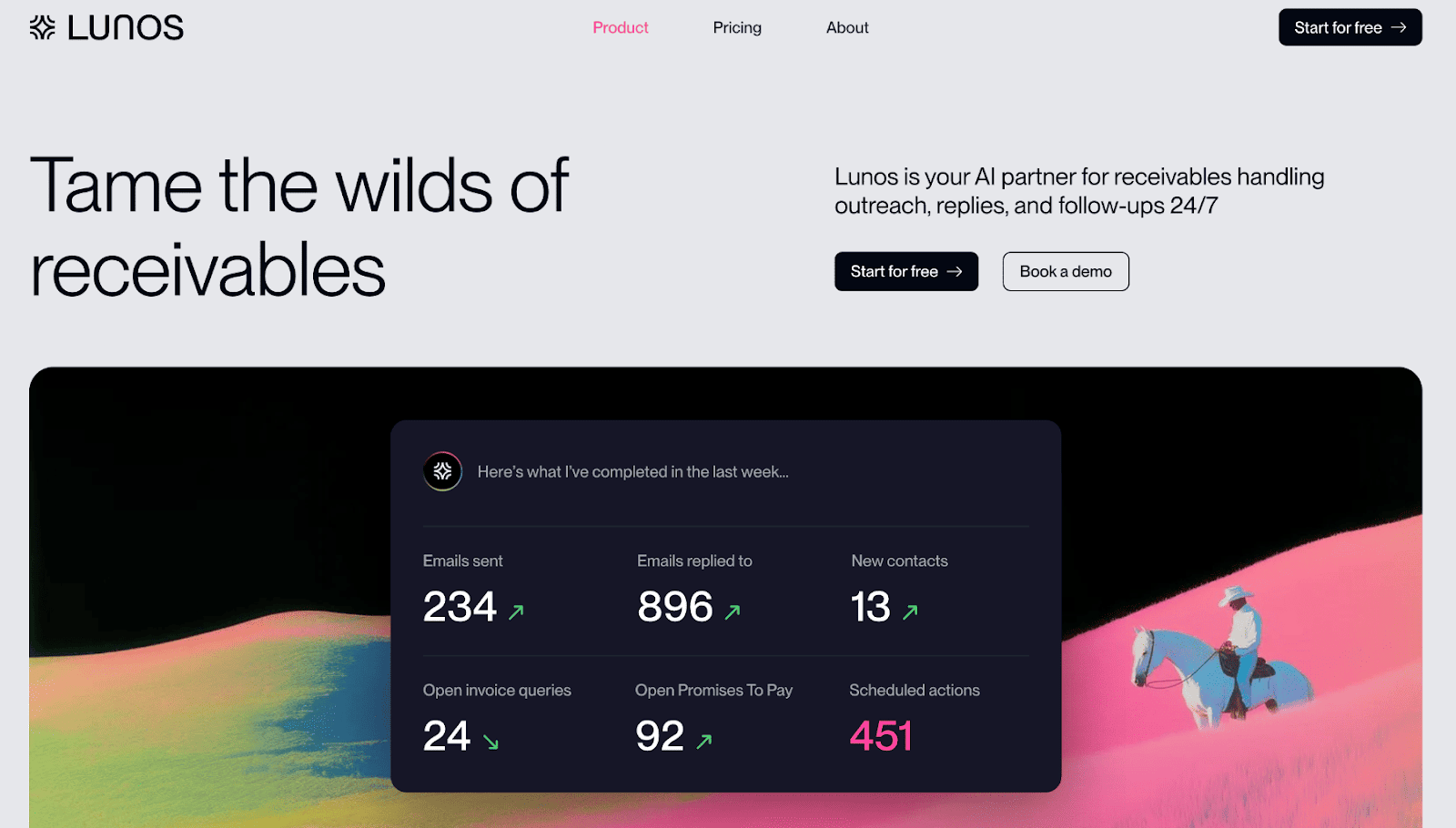
While traditional AR automation just sends templated emails on a schedule, Lunos does what effective collectors do: it reads customer responses, understands what they mean, and adapts its approach accordingly.
Here's what that means for your CEI:
Two-way conversational intelligence that captures payment commitments
Lunos stands out from most AR automation tools because of its two-way conversational intelligence. This means it recognizes the intent and meaning behind customer communications, responds accordingly, and records the commitment for your cash forecasting.
If the customer says, "I think we already paid this invoice," Lunos flags it as a potential dispute or payment application issue. In that case, it immediately routes it to the right person on your team. You don't lose days or weeks because no one noticed the response.
This matters for CEI because nothing slips through the cracks. Every payment promise gets tracked and followed up on. Every dispute surfaces immediately. Every customer gets the right follow-up at the right time.
Adaptive follow-up that preserves relationships while driving collection
Every customer is different. Your best customer, who's 5 days late, needs a friendly check-in. Not an aggressive dunning letter. The chronic late payer who's 30 days past due needs a firmer message.
Lunos adjusts its tone, timing, and messaging based on payment history, relationship importance, and customer behavior patterns. Personalization happens automatically at scale, which is impossible to maintain manually when you're dealing with hundreds or thousands of invoices.
Better relationships mean better payment behavior, which directly improves CEI. Customers respond more positively to relevant, appropriately-toned communication than to generic automated reminders.
Slack-native workflow that keeps your team in control
Your team doesn't learn a new platform or log into yet another system. All collaboration happens right in Slack, where you already work.
Lunos sends daily summaries, flags exceptions that need human attention, and lets you approve suggested actions, all without leaving Slack. When Lunos identifies a dispute or complex situation, it immediately involves your team. You stay in control while Lunos handles the repetitive work.
Complete visibility into every interaction
Every message Lunos sends, every customer response, every payment promise, it's all tracked in real time. You get the full audit trail for compliance, and more importantly, you get accurate data for forecasting when cash is actually coming in.
This visibility matters for CEI because it shows exactly why it's moving up or down. Are certain customer segments consistently failing to pay? Are disputes taking too long to resolve? Is follow-up timing off? You have the data to diagnose and fix issues.
Three autonomy modes so you maintain control
Start with Monitor mode, where you review everything before it goes out. Move to Suggest mode where Lunos proposes actions, and you approve them. When you're comfortable, use Act mode, where Lunos handles routine follow-ups automatically and flags only exceptions.
This graduated autonomy means you can start conservatively and increase automation as you build trust, rather than being forced into an all-or-nothing approach.
Lunos’ CEI Impact
Teams using Lunos typically see approximately 75% reduction in AR workload within weeks. That time is redirected to strategic work, such as analyzing trends, improving processes, and handling complex customer situations that genuinely require human judgment.
Because Lunos is consistent, never forgets follow-ups, reads every customer response, and adapts to each situation in real time, CEI improves significantly. Receivables don't sit unnoticed. Payment promises get tracked and followed up on. Disputes get surfaced and resolved faster.
It's like having a team member who works 24/7, never gets overwhelmed, reads every single customer email, remembers every payment commitment, and knows exactly when and how to follow up with each customer. Except it's not a person. It's an AI coworker that works alongside your existing team.
Ready to see how an AI coworker can improve your collection effectiveness index (CEI)?
Start for free with Lunos and discover how finance teams are boosting collection effectiveness without adding headcount.
Frequently Asked Questions about Collection Effectiveness Index (CEI)
What's the difference between CEI and DSO?
CEI measures the percentage of your receivables you actually collect, focusing on quality, while DSO tracks the speed of collection. Fast collections (good DSO) can still miss money if CEI is low.
What's considered a good CEI score?
Generally, a CEI above 85% is excellent, 70–84% is good, and below 70% signals issues. Benchmarks vary by industry, but tracking your trend over time matters more than a single number.
How often should I calculate CEI?
Most B2B companies calculate CEI monthly or quarterly. Monthly calculations provide timely insights and help identify trends early.
Why is my CEI dropping even though my team is working hard?
A declining CEI often signals higher-risk customers, unscalable manual processes, or missed responses and disputes. Tools like Lunos help by handling volume, automating repetitive tasks, and letting your team focus on high-value work.
How does an AI coworker improve CEI better than traditional automation?
Traditional automation only sends emails, but Lunos reads and understands customer replies, tracks commitments, identifies disputes, and adapts follow-ups as a human collector would. This ensures nothing slips through, disputes resolve faster, and CEI improves beyond basic automation.
Make your receivables effortless and focus on what you do best