The Accounts Receivable Process: 8 Steps Explained
Quick Summary
- AR is a lifecycle, not a task. It runs from the credit decision to the reconciled payment, and a weak link anywhere slows the whole chain
- Most of the real cost gets set up front, not chased at the end. A clean credit decision and a correct invoice are cheaper than any amount of follow-up
- The pre-due confirmation is the highest-value, most-skipped step. Catching a missing PO before the due date saves the entire past-due cycle
- Aging has a summary and a worklist, and they aren't the same thing. Act on which accounts are moving, not the total
- Collectability falls sharply with age. A receivable is far more likely to be recovered at 90 days than at six months, which is the whole case for working accounts early
- Cash application ends the process, not the collection call. AR isn't finished until the payment is matched to the right invoice
- The moment a dispute is raised, the invoice leaves the chase loop. Chasing a disputed invoice is one of the fastest ways to burn a relationship
- Every stage has a done-well version and an at-scale version. Most AR value gets lost between the two
The 8 steps of the accounts receivable process
AR is a lifecycle. It runs from the moment you extend credit to the moment cash is reconciled, each stage feeds the next, and a weak link anywhere slows the whole chain.
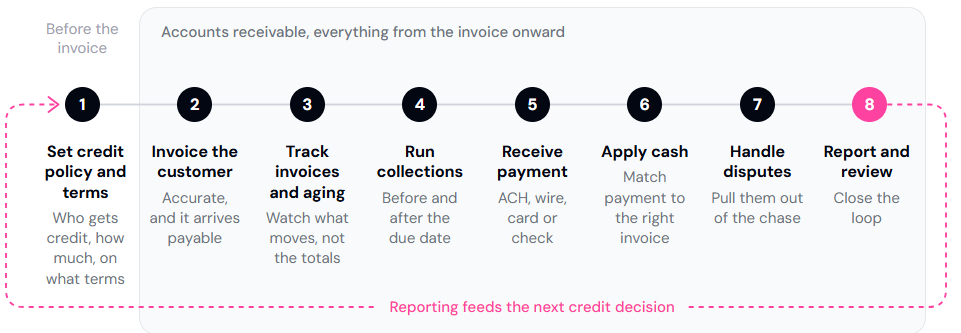
For each step below, we name what it looks like done well against what it degrades into under volume. That contrast is the real story of AR.
Step 1: Set credit policy and terms
Before you invoice anyone, decide who gets credit and on what terms.
Run basic credit checks on new customers, using trade references, a credit report, or a scoring service for larger exposures. Set payment terms, credit limits, and the conditions for extending more. A fence costs less than a search party.
Capture the payer's real AP process up front. Do they use a portal? Do they require a PO? When is their payment run? Twenty minutes of questions now saves weeks of chasing later.
Done well: terms match the risk, and you know exactly how each customer pays before the first invoice.
At scale: terms get set by habit, the AP details never get captured, and you learn how a customer pays only when the invoice goes missing.
Step 2: Invoice the customer
Send an accurate invoice the day the work is done. Include the right PO number, tax details, line items, due date, and remit-to information.
As customers get more sophisticated, more of them mandate AP portals like Coupa, Ariba, Tipalti, or Basware, require a valid PO on every invoice, or need a specific format. A growing share of invoices never arrive in a payable state. They sit unread in an AP team's inbox, or never get uploaded to the portal at all.
The customer would pay, if there were anything payable in front of them. Modern tools ease this pressure by automating portal uploads, so teams can work smoothly regardless of which portal a customer requires. Speed and accuracy here pay off directly in faster collection.
Done well: every invoice lands with the right contact, in the right channel, with a valid PO, the first time.
At scale: a quiet fraction of invoices fail to arrive payable, and you find out account by account, far too late.
Step 3: Track invoices and aging
Once invoices are out, watch them. Group open invoices by how long they have been outstanding. This is your aging report, and it tells you at a glance which accounts need attention and which are still inside terms.
A typical aging report uses buckets: current, 1 to 30 days past due, 31 to 60, 61 to 90, and 90-plus. The further right a balance sits, the higher the risk it never gets paid.
The summary and the detail tell you different things. The summary is a report. The detail, which specific accounts are sliding from 30 to 60 to 90, is a worklist. Work the movement, not the totals.
Why collectability falls with age
The case for the aging detail rests on measurement rather than intuition.
Collectability decays sharply as an invoice ages. A receivable is far more likely to be recovered at 30 days past due than at 90, and the drop past 90 is steep. Dun & Bradstreet's quarterly AR aging reports track exactly this deterioration by industry, and the Credit Research Foundation benchmarks collectability by aging bucket for the same reason.
The curve runs in one direction. A dollar sitting at 30 days is a very different asset from the same dollar sitting at 90, even though both show up as the identical figure in a total-AR number.
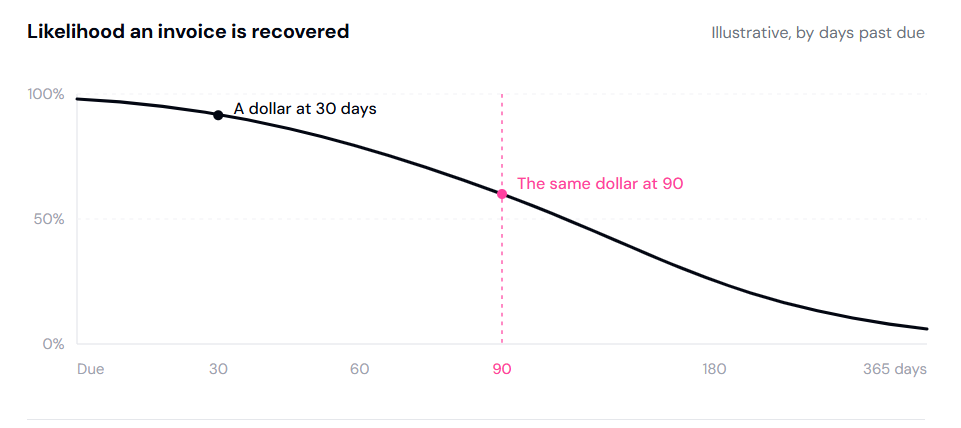
It's also the entire argument for working accounts early rather than working them hard. A follow-up at day 10 has a much better chance of succeeding than the same follow-up delayed to day 70, no matter how firm the tone.
Done well: you review aging weekly and work the accounts that are moving.
At scale: you glance at the summary around the end of the month, by which point the movement already happened.
Step 4: Run collections
This is the follow-up work. You send reminders before and after the due date, escalate when invoices go past due, and handle replies as they come in.
Tone and timing matter. You want to be firm without damaging the relationship, and a steady cadence beats a flurry of panicked emails at quarter-end. Many teams build a dunning sequence, a planned series of reminders that steps up in urgency as an invoice ages, then a reminder on the day it falls due, then firmer follow-ups. At some point a phone call replaces an email, and a serious case may move to an agency or legal route. The skill is matching the pressure to the relationship and the risk.

The single most valuable touch comes before any of that. A pre-due confirmation, sent a few days ahead of the due date, checks that the invoice arrived, the PO matches, and you're talking to the right person. Most late payment is decided there, while the invoice is still current, which is why skipping it costs more than skipping any reminder after it.
Collections is deep enough to be its own discipline, so this guide keeps it short. For the full mechanics, including the escalation ladder by days past due, channel strategy, and account segmentation, see the complete accounts receivable collections guide.
Done well: every account gets outreach matched to its history and relationship.
At scale: the top few accounts get attention, and the long tail drops to a generic sequence from a no-reply address.
Step 5: Receive payment
The customer pays. Payment might arrive by ACH, wire, card, or check, and it might cover one invoice or several at once.
Each method carries its own remittance details, which set up the next step. A clean payment with clear remittance is easy. A lump sum covering twelve invoices with no breakdown is a puzzle, and your team has to solve it before the cash can move.
You can shrink the puzzle before it arrives. A payment link on the invoice and a remittance address printed on every document cost nothing, and between them they turn most lump sums into clean matches.
Done well: remittance is captured cleanly and matched the same day.
At scale: payments pile up faster than anyone can match them, and the backlog starts to distort your books.
Step 6: Apply cash
Now you match each payment to the right invoice and post it to your ledger.
Partial payments, short pays, deductions, and missing remittance all make matching slow and error-prone. A payment that doesn't match cleanly becomes an exception, and exceptions eat hours. Until cash is applied, your AR records are out of date, which throws off every report built on them.
Worse, unapplied cash creates false past-dues. You chase a customer who already paid because your records haven't caught up. Few mistakes burn goodwill faster, and the usual culprit is scale.
This step has enough depth to earn its own page. The full breakdown, including why matching gets harder at volume and how manual, rule-based, and agentic approaches compare, is in our guide to the cash application process.
Done well: cash is applied same-day, so credit frees up and the aging report tells the truth.
At scale: a cash-app backlog builds, false past-dues go out, and reconciliation drifts.
Step 7: Handle disputes and deductions
The moment a customer raises a dispute, that invoice has to come out of the chase loop. Chasing a disputed invoice is one of the fastest ways to burn a relationship.
Route the dispute to whoever can resolve it, and give it a clear owner and a resolution path. Deductions are their own category. Short pays, claimed discounts, and chargebacks need coding and a resolution, not a dunning notice.
Disputes cost you twice. They hold the cash now, and if the root cause is an invoicing or delivery problem, they keep coming back until you fix the source. For the full mechanics of triage and the specific deduction types, see the collections guide's section on disputes. Dispute management software can also help teams organize and process these claims.
Done well: disputes are caught early, pulled from the chase, and resolved before they age.
At scale: disputes sit in an inbox, the invoice keeps getting chased, and the relationship frays.
Step 8: Report and review
Finally, you measure how the whole process performed. You review aging and track your key metrics, looking for the accounts and patterns that need a different approach.
Reporting closes the loop back into credit policy and collections strategy, and the useful version is specific. If the aging detail shows your mid-market segment sliding into 31 to 60 days every quarter-end, that's a terms conversation, so new accounts in that segment move to net 30 with a pre-due confirmation. If the dispute rate on one product line is double the rest, that's an invoicing problem upstream, so you fix the template before you chase another invoice. Each review should change one decision for the month ahead.
Done well: the numbers feed real decisions each week.
At scale: the dashboard gets admired and nothing changes.
Accounts receivable best practices
Most AR problems have a practical fix, and none of them requires a system overhaul to start.
- Set clear credit terms upfront. Agree on terms and limits before you deliver, not after a payment is late
- Invoice accurately and fast. Get the invoice right the first time and send it the day the work is done
- Build a consistent reminder cadence. Decide your timing, channels, and tone in advance, then follow it for every account
- Make it easy to pay. Offer clear payment options and put a payment link right in the invoice
- Review aging weekly. A quick weekly look keeps small problems from becoming write-offs
- Handle disputes early. Flag and resolve disputes the moment they appear, before they age
- Segment your accounts. Treat a key strategic customer differently from a habitual late payer
- Keep finance, sales, and CS aligned. The people who own the customer relationship can often unstick a payment faster than a reminder can
Consistency does most of the work here. A predictable process collects more than a heroic effort at the end of the quarter.
It helps to separate the rule from the relationship. The cadence and the terms should be standard and applied to everyone. The conversation, the tone, and the judgment about when to push or wait should flex by account. Teams that get this balance right collect more without burning goodwill.
Where the AR process breaks down at scale
AR breaks at the start, in data and setup, long before anything shows up in collections. Teams fixate on the chase because that's where the missing cash surfaces, but by then the failure already happened three steps upstream.
In rough order of what breaks first:
- The account data fragments. At small scale, one person holds the whole account, the real payer, the disputes, the promises. As you grow, that context scatters across the ERP, the CRM, the inbox, the payment provider, and memory. Once nobody holds the full picture, every downstream mistake starts here
- Invoice delivery quietly fails. As more customers mandate portals and POs, a growing share of invoices never arrive payable
- Contact data goes stale. The billing contact left or the AP function got outsourced, and now the email bounces. At scale, thousands of accounts decay into dead addresses, and the collections problem is really an emailing-the-void problem
- The long tail gets abandoned. A collector can work a few dozen accounts. Past that, everything drops to a fixed sequence or nothing. That cash is recoverable. It ages out on the open range because nobody had the hands to ride after it
- Cash application falls behind. Matching gets harder with volume, unapplied cash builds, and false past-dues go out. A scale problem, and rarely the customer's fault
- Standardization replaces judgment. To cope, teams collapse account judgment into a few crude segments and a fixed calendar. The process still runs. It just stops being good, treating a strategic account and a small long-tail invoice the same way
Every one of these is a bandwidth failure. Teams know what good looks like. They run out of hands, so they drop the long tail and let the data fragment.
See how Lunos solves this
People know the steps. What nobody has is the capacity to run all eight on every account. Lunos AI accounts receivable agents run the repetitive steps end to end, and route the judgment calls to your team.
FAQs
What are the steps in the accounts receivable process?
The process moves through setting credit terms, invoicing, tracking and aging, collecting, receiving payment, applying cash, handling disputes, and reporting. Each step feeds the next, so a weak link slows the whole chain.
What is the difference between the AR process and the order-to-cash process?
Order-to-cash is the full cycle, from order to reconciled payment. Accounts receivable is the back half, everything from the invoice onward. AR sits inside order-to-cash, which is usually where the delay lives.
Who is responsible for the accounts receivable process?
On a small team, one person. At scale, it splits. An AR analyst invoices and applies cash, a collections specialist runs follow-ups, a credit manager sets terms, and the controller and CFO own the accounting and the cash outcome.
How quickly does an unpaid invoice become uncollectible?
Collectability decays steadily from the due date and drops sharply past 90 days. The accounts worth working hardest are the ones that just crossed into being overdue, not the ones that have been overdue for months.
What worked at 200 customers breaks at 2,000
Lunos scales the whole AR process without adding headcount, running invoicing follow-ups, collections, cash application, and dispute routing in one place. Book a demo to see all eight steps running together.