

Summarize:


How to Improve Your Cash Application Process With AI Agents


Quick Summary
The cash application process stalls when payment details are scattered across emails, remittance files, and disconnected systems. AI agents close that gap by automating payment matching, handling exception follow-ups, and keeping reconciliation moving without manual intervention.
What Is the Cash Application Process?
Cash application is the process of matching a customer's payment to the specific open invoice it covers. While it sounds like simple bookkeeping, it is actually an exercise in data matching and intent recognition.
The process begins when a payment hits your bank account. However, the money is only half the story. To apply that cash, your finance team needs the remittance advice: the customer's instructions detailing which invoices they are settling and whether they have taken any deductions.
Once the payment and remittance are paired, finance teams must locate the corresponding entries in the ERP and verify that the amounts match before closing the record. This stage often stalls when a single lump sum covers dozens of invoices, requiring someone to manually check the data.
The final hurdle is managing exceptions, such as payments that arrive without instructions or unexplained short-payments. Clearing these quickly is vital. The faster you apply cash, the more accurate your credit limits and cash flow forecasts become.
Why Listen to Us
The Lunos team has deep roots in fintech and payments, with leadership from GoCardless. We built Lunos because receivables is a communication problem, not just a technical one, and legacy automation ignores the context and intent behind every payment.

Common Challenges in Traditional Cash Application
The cash application process rarely follows a clean path. Payments and remittance details arrive from different places, and the information you need to apply them is not always complete. As payment volume grows, small issues quickly turn into daily hurdles for finance teams.
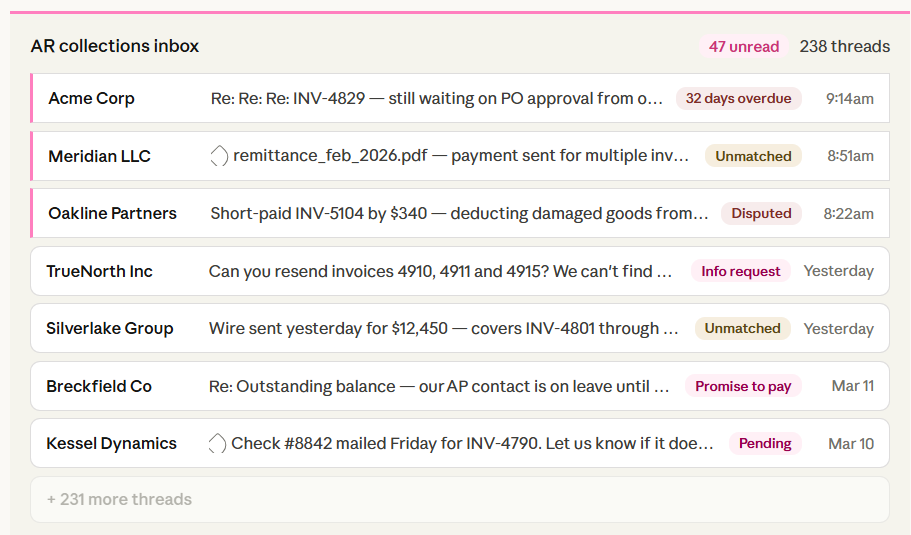
Common challenges include:
- Fragmented data sources: Payments arrive via ACH, wire, and credit card, but the instructions for applying that money rarely arrive in the same format. Finance teams spend hours hunting for remittance advice in PDF attachments, email bodies, and web portals.
- Missing or incomplete information: It is common for a payment to arrive without any context. When an amount does not match an open invoice, often due to unearned discounts or internal disputes, it sits in an unapplied cash account, which artificially inflates your DSO.
- Complex lump-sum payments: Large customers often send a single payment to cover dozens of invoices across multiple subsidiaries. Manually unpicking these transactions to ensure the sub-ledger remains accurate is a slow, error-prone process.
- Stagnant exception handling: When a payment does not match, the process stops. Resolving these misfits requires constant back-and-forth communication with customers, delays in financial reporting, and inaccurately high credit limits.
When these issues pile up, cash application becomes a time-consuming process rather than a routine task. Finance teams spend more time investigating payments and less time focusing on higher-value work.
Why Traditional Automation Falls Short
Many finance teams believe they have already automated this process using legacy software or built-in ERP tools. However, these systems often hit a glass ceiling because they rely on rigid, rules-based logic.
The primary limitation is the rigidity trap. Traditional automation follows a strict "if-this-then-that" structure. If a customer changes their remittance PDF layout by moving a column or adding a new header, the system fails to recognise the data. This requires a human to step in and re-map the template, turning what should be a hands-off process into a constant maintenance task.
Legacy tools also struggle with unstructured data. While they can sometimes pull text from a clean document, they cannot read an email's body. If a customer sends a payment and simply types "deducting $100 for a short-shipment" into the email thread, a standard automation tool will flag it as an error.
Because these systems lack the ability to reason through context, they struggle with:
- Short-payments: Differentiating between a simple bank fee and a legitimate trade dispute.
- Cross-subsidiary matching: Linking a parent company's payment to a subsidiary company's invoice without a pre-set rule.
- Passive workflows: Traditional software is silent; it can flag a problem, but cannot reach out to a customer to request the missing details.
Ultimately, traditional automation only handles the easy, predictable transactions. The complex, messy cases still require manual intervention, which means your team never actually escapes the spreadsheet.
How AI Agents Improve the Cash Application Process
While traditional software follows rigid rules, AI agents observe, learn, and act like an experienced member of your team.
Here’s how AI agents optimize your cash application process:
1. Centralize All Payment and Remittance Data
AI agents work best when they have a complete view of your incoming cash. Instead of having a specialist log into five different bank portals or hunt through shared inboxes, you should route all payment sources into a single data stream.
The agent can then monitor these channels in real-time, pulling in bank tags, EDI files, and email attachments simultaneously.
2. Automate Remittance Data Capture
One of the biggest time-wasters is manually typing data from a PDF into an ERP.
AI agents go beyond basic scanning by reading the document's context. They can extract invoice numbers, dates, and amounts from a messy Excel sheet or the body of a customer’s email.
This removes the need for template mapping because the agent understands what a "short-payment" or "credit note" looks like, regardless of the layout.
3. Intelligent Payment Matching
In a typical day, a customer might pay for 10 invoices in a lump sum or accidentally overpay by a few cents.
An AI agent does not just look for exact matches; it looks for patterns. It can intelligently link a parent company’s payment to its subsidiaries or recognize that a $498 payment is intended for a $500 invoice after accounting for a standard bank fee.
4. Automate Exception Detection
Instead of waiting for a human to find an error during month-end reconciliation, AI agents flag discrepancies the moment they happen.
If a customer pays less than the invoiced amount, the agent can automatically categorise the reason, such as a trade discount or a pricing dispute, and surface it for your team to review. This ensures your unapplied cash account stays near zero.
5. Enable Continuous Reconciliation
Most firms process payments in batches once or twice a week.
AI agents allow for a continuous workflow. As soon as a payment hits the bank, the agent matches it and updates the ledger. This keeps your credit limits accurate and ensures your collections team isn't calling customers who have already paid.
6. Improve Visibility With Real-Time Dashboards
When your cash application is automated, your data is always up to date. This allows you to move away from static spreadsheets and toward live dashboards.
You can see exactly how much cash is in transit, which customers consistently pay late, and where your bottlenecks are, without waiting for a weekly report.
7. Track Key Cash Application Metrics
To truly improve your cash application process, you need to measure the right numbers. AI agents make it easy to track:
- Touchless cash application rate: The percentage of payments applied without any human intervention.
- Unapplied cash percentage: How much money is sitting in your accounts without being matched to specific invoices?
- Payment posting time: How long does it take from the moment a payment is received until it is reflected in the ERP?
For a broader view of AR health, tracking your collection effectiveness index alongside these metrics shows how much of your total receivables you're actually converting to cash.
How Lunos AI Improves Your Cash Application Process
Lunos acts as an AI coworker that handles the manual process of your receivables. Instead of your team spending hours on data entry, Lunos manages the end-to-end matching process while keeping you in total control.
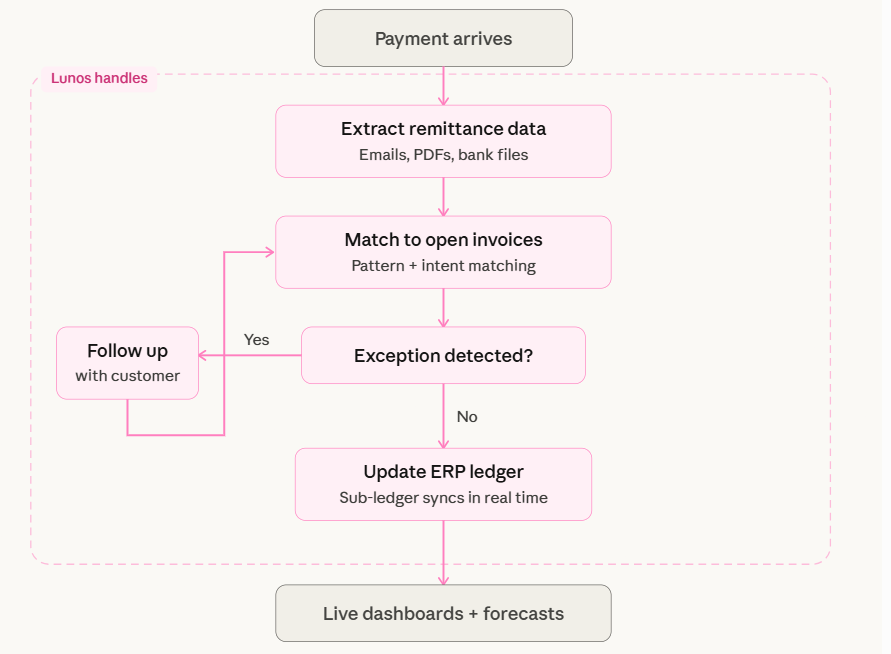
Here is how Lunos AI agent improves your cash application process:
Automates Payment Matching
Lunos doesn't rely on rigid rules. It analyses payment patterns and historical data to link incoming cash to the correct invoices.
Even when a customer pays a lump sum without a reference number, Lunos AI identifies the intent and suggests the match, shifting your team from data entry to simple oversight.
Streamlines Remittance Processing
The scavenger hunt for remittance ends here.
Lunos monitors your finance inboxes to pull data directly from email bodies and PDF attachments. It standardises this messy information so your ERP can understand it, ensuring payments don't sit in unapplied accounts just because a customer's instructions were unclear.
Proactive Exception Handling
When a payment doesn't match, perhaps due to a short-payment or a bank fee, Lunos identifies the likely reason.
Rather than just flagging an error, it can reach out to the customer to clarify the deduction. It handles back-and-forth communication professionally, looping in your team only when a strategic decision is needed.
Real-Time Visibility and Integration
Lunos connects directly with NetSuite, Xero, and QuickBooks.
Once a payment is matched, your sub-ledger updates instantly. This gives your Controller and CFO a live view of DSO and cash flow, removing the need for manual spreadsheet updates or weekly batch processing.
Results Finance Teams See After Improving Cash Application
Adopting AI agents for your cash application does more than speed up data entry; it fundamentally expands the capacity of your finance department.
Here are the key benefits you get:
- Faster payment reconciliation: Because AI agents process transactions the moment they hit the bank, the batch processing delay disappears. This real-time application ensures your accounts receivable ledger is always current.
- Reduced unapplied cash: AI keeps your unapplied cash percentage near zero by automatically identifying short-payments and requesting missing remittance data. This prevents mystery payments from sitting in suspense accounts.
- Significant workload reduction: Finance teams often see their AR manual workload reduced by up to 75%. This allows them to stop acting as data entry clerks and focus on high-level strategy, such as managing complex disputes.
- Improved forecast accuracy: When your data updates in real time, cash flow forecasting becomes a reliable tool rather than a best guess. Leadership can make faster decisions because they have full visibility into true liquidity.
- Scalability without headcount: As invoice volumes grow, your team does not have to. An AI agent handles thousands of transactions with the same precision as a dozen, allowing you to scale without increasing back-office overhead.
Why Finance Teams Are Turning to AI for Cash Application
Manual cash application is no longer sustainable for growing businesses. Relying on spreadsheets and shared inboxes creates a capacity crisis, forcing finance teams to choose between adding expensive headcount or falling behind on collections.
Lunos AI solves this by moving beyond rigid, rules-based automation.
As an AI coworker, it understands the context of a payment, manages two-way conversations to clear up discrepancies, and handles the repetitive matching that usually stalls your workflow.
This allows your finance team to focus on high-value strategy while the manual work happens autonomously in the background.
Ready to scale your AR without the extra headcount? Get started with Lunos today.
Frequently Asked Questions
How does AI handle payments without remittance?
Unlike rigid tools that fail on blind payments, AI agents use historical patterns and semantic matching to identify the source.
If the intent is still unclear, the agent can autonomously email the customer to request missing details, keeping the cash application process moving without manual intervention.
Can AI distinguish between bank fees and disputes?
Yes. AI agents recognize financial context rather than just searching for exact matches.
They identify small, standard discrepancies as bank fees or FX differences and code them accordingly. For larger short-payments, the agent flags the potential dispute and summarizes the invoice history for your team.
Does AI cash application require a new ERP?
No. AI agents sit on top of your current stack, connecting via API to systems like NetSuite, SAP, or Oracle.
The agent acts as a specialized coworker that handles the detective work before posting the finished results back into your existing system of record.
Make your receivables effortless and focus on what you do best