

Summarize:


HighRadius vs YayPay: which AR tool fits your finance team?
HighRadius is an enterprise order-to-cash platform with deep SAP and Oracle integrations, running AI agents inside workflows that are built to make human collectors faster. YayPay (now Quadient AR) is a mid-market collections tool with strong payment forecasting. Lunos is an AI coworker that works receivables the way a person on your team would, reading what customers write back and acting on it,

Janine Sullivan
19 October 2026

Quick summary
HighRadius is an enterprise order-to-cash platform with deep SAP and Oracle integrations, running AI agents inside workflows that are built to make human collectors faster. YayPay (now Quadient AR) is a mid-market collections tool with strong payment forecasting. Lunos is an AI coworker that works receivables the way a person on your team would, reading what customers write back and acting on it, with published pricing from 0.3% on collections.
| Tool | Key feature | Key limitation | Best for |
|---|---|---|---|
| HighRadius | Full order-to-cash platform, with AI agents inside the workflows | Built to speed up human collectors, not replace them. 3-6 month implementation, no public pricing | Large enterprises on SAP or Oracle |
| YayPay (Quadient AR) | Predictive analytics | Limited customization, mid-market ceiling | Mid-market B2B teams (51-1,000 employees) |
| Lunos | An AI coworker that works receivables the way your best AR person would | No deep SAP or Oracle integration, shorter track record | Growing B2B teams wanting AI-driven AR |
The sections below compare HighRadius and YayPay on the size of team each one is built for, where each is stronger, what they cost, and the job that neither of them does.
Why listen to us
We built Lunos to handle the part of AR that existing tools leave to your team. Johan Strid, VP Finance at Swap, put it simply after going live:

At Workweek, CFO Ramya Varma watched DSO drop from around 46 or 47 days to closer to 36. Those results came from finance teams handling anywhere from 500 to 50,000 invoices a month, with the AI running the customer conversations end to end.
HighRadius vs YayPay: head to head
Both tools do the same core job. Invoices go out, reminders chase them on a schedule, and a dashboard reports DSO and aging back to you. Escalations fire on their own as the debt gets older. Both connect to your ERP, and both do that part properly.
They split on the size of company they're built for, and on how much of the finance stack they try to own. Everything below follows from those two things.
Company size and ERP fit: HighRadius for enterprise, YayPay for mid-market
HighRadius is an end-to-end finance automation suite for the Office of the CFO. It runs 190+ AI agents across credit, collections, cash application, deductions and electronic invoicing, most of them built to help a collector work faster rather than to finish the work themselves. It integrates deeply with SAP and Oracle.
YayPay is narrower by design. Quadient acquired it in July 2020 and rebranded it Quadient Accounts Receivable. It handles collections, invoicing, credit and cash application for mid-market B2B teams. It connects to NetSuite, Salesforce, SAP, Microsoft Dynamics, Sage, QuickBooks and Xero.
That difference decides more than any feature list will. If you're running multi-entity AR on SAP or Oracle, HighRadius is the only one of the two built for it. If your ledger is NetSuite or QuickBooks and your AR team is under twenty people, it's more suite than the problem needs.
Multi-entity is the sharpest test. If your receivables sit across several legal entities, with consolidated customer hierarchies and one customer trading with three of your subsidiaries, that's the shape HighRadius was designed around and the reason its implementation runs into months. YayPay segments reporting, dashboards and aging by billing subsidiary, so a group-level view is work you do outside the tool.
Team size is the second test. Below about twenty collectors, most of what HighRadius charges for goes unused, and the rollout costs you a quarter or two of running the old process while it lands. Once you're running a credit function and a deductions queue alongside collections, YayPay runs out of room.
Scope, pricing, implementation time and the reply problem all read differently depending on which side of that line you sit. Read the sections below with your answer to this one already settled.
Scope: HighRadius covers the full order-to-cash cycle
HighRadius handles credit, collections, cash application, deductions and e-invoicing in one place. That's why it replaces several tools for a large finance team, and it's also why it's heavy going for a small one. A team that needs two of those spends its day looking at somebody else's job.
YayPay stops at collections, invoicing, credit and cash application. If your AR needs sit inside those boundaries, that's a strength, because there's less product to learn and less to configure. If they don't, you'll find the ceiling early.
Cash application and deductions: HighRadius leads
HighRadius matches incoming payments against open invoices with machine learning. That includes the ones that arrive with incomplete remittance data, which is the case that quietly eats hours by hand. Deductions get a dedicated workflow rather than an exception queue.
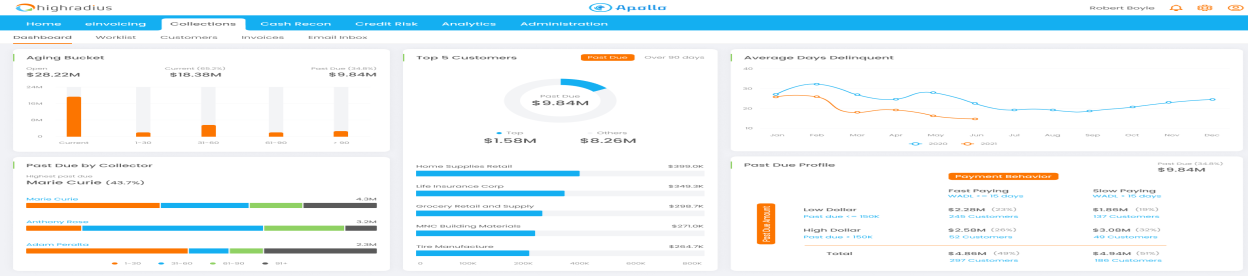
Credit is a full module too, with automated scoring models, real-time risk monitoring and online credit applications. Invoice delivery runs across email and AP portals, so nobody's formatting a document per buyer. Collector worklists are prioritized by risk score.
YayPay does cash application as well, and it copes with remittance data arriving in different formats. Deductions management isn't part of its scope.
Payment forecasting and dashboards: YayPay leads
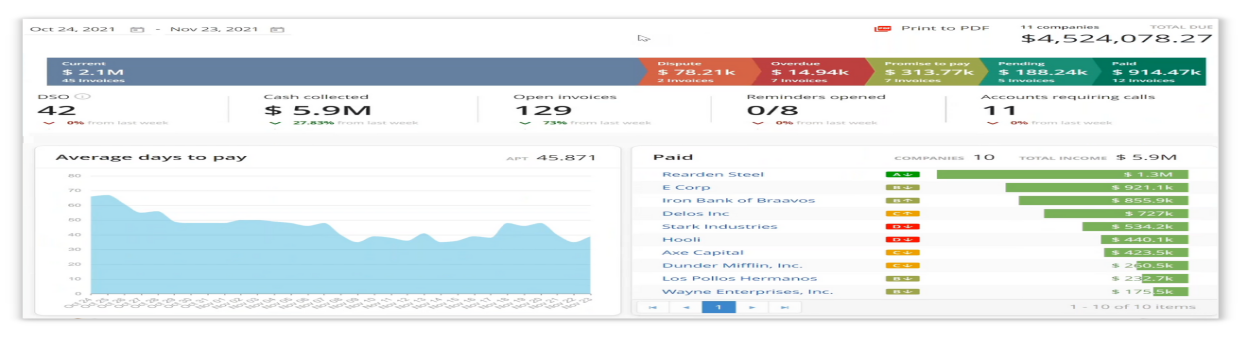
Forecasting is the strongest thing YayPay does. Its models train on your own payment history to predict when each customer will pay. That turns a flat aging report into a ranked list of who to chase today.
HighRadius scores credit risk, which answers a different question. Knowing a customer is creditworthy doesn't tell you when they'll pay. That's the gap YayPay's forecasting fills.
The reporting around it is solid. Dashboards track DSO, aging and collection performance across the whole book, and you can customize what they show. Multi-step dunning sequences send reminders and escalate automatically as invoices age.
Pricing: neither one publishes a number
Neither one offers public pricing. HighRadius quotes on modules, transaction volume and company size. Quadient quotes on invoice volume and business size, and every package includes unlimited users, unlimited automation rules and ERP integrations. Both route you through a demo before you see a figure.
Since February 2026 HighRadius has also offered an outcome-based option. There's no implementation fee and nothing to pay until go-live, and after that it takes a share of the improvement against agreed success criteria. That takes the upfront risk off the table, though it won't tell you what year two costs.
Plan around the shape instead of a number. Both are a subscription that grows with your volume and your user count, plus implementation, quoted after a call. If a page confidently quotes you a monthly starting price for either one, it's been invented.
For contrast, Lunos publishes its rates in full, starting at 0.3% on collections and topping out at a $15,000 annual plan before enterprise volumes.
Implementation time: months versus weeks
HighRadius quotes three to six months to implement, and G2 reviewers report eight on average, so you're running the old manual process through the whole onboarding. That's the hidden cost of the rollout, and it rarely shows up in the quote.
YayPay goes live in weeks. It's lighter, there's less to configure, and it drops into a standard mid-market stack without custom integration work.
Where you'll meet the edges is customization. Workflows that don't match YayPay's standard setup have firm limits on how far you can bend them. Reviewers also report no universal search across the book, and bulk payments that get awkward when a customer settles fifty or seventy-five invoices at once.
Handling customer replies: standard requests only
This is where the two of them stop short, and the gap is expensive. Both products handle the sending. Reminders go out on schedule, escalations fire as invoices age, and that half of the job is handled. Then the customer replies, and how far each one gets depends on what they said.
HighRadius reads inbound email, identifies the customer, classifies the message, summarizes the thread and drafts a response with the invoice copy or statement attached. It calls that an assisted agent, so a collector approves what goes out. Standard requests are handled well. YayPay leaves the whole of it to your team.
It's the rest that costs you. A query on a line item, a dispute about a delivery, a short payment with a reason attached, a promise to pay on a date somebody now has to track. Classifying those is not the same as resolving them, and both products hand them to a person. The hours you saved on chasing go straight back into reading, deciding and routing.
Phone is the one channel where HighRadius goes further. Its parallel dialer works a list of past-due accounts, connects the first customer to answer and leaves voicemails on the rest. Its virtual call attendant answers inbound calls around the clock, logging promises to pay and disputes and emailing invoice copies during the call. YayPay has no equivalent, so there somebody on your team still picks up the phone.
The same limit applies on the phone as in the inbox. Standard requests get handled. A customer explaining why they've short paid still ends up with one of your people.
HighRadius vs YayPay: which should you choose?
Pick HighRadius if
You're a large finance organization with serious volume in cash application, deductions and credit reviews. You're on SAP or Oracle, and you've got the people to run a three to six month rollout. Depth at scale is what you're paying for, and you'll use enough of it to justify the price.
Pick YayPay if
You're a mid-market team that wants collections chased, payment dates forecast and clean AR dashboards, without an enterprise project attached. It's lighter than HighRadius and it goes live in weeks. At a few hundred to a few thousand invoices a month, that's the better trade.
Pick an AI coworker if
Your invoices go out fine. They just don't get paid on time, and the hours go on chasing them, reading what comes back and working out what to do about it. That's a narrower job than either suite is built for, and it's the one we built Lunos to do. Cash application comes with it, because a payment that turns up with no remittance advice is the same problem wearing a different hat.
The best HighRadius and YayPay alternative: Lunos
Best for: growing B2B teams who want the replies handled as well as the chasing.
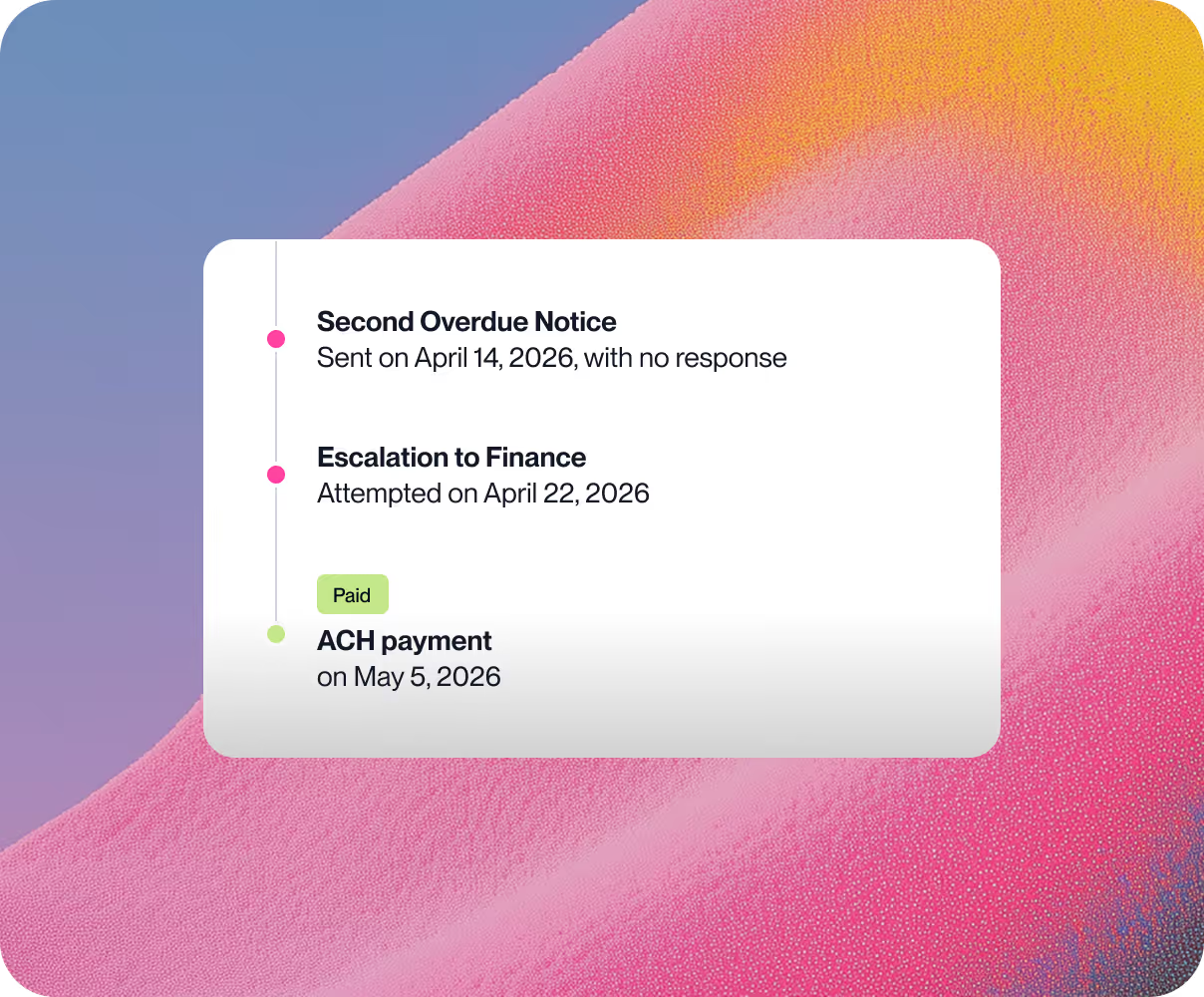
We build a separate agent for each stage of the receivables cycle. They share one view of the customer, so an invoice keeps its history when it moves from chasing to a dispute to cash application.
- Collections agent: works the follow-up cycle, reads replies, records promises to pay, and escalates when an account stops responding
- Dispute management: recognizes a dispute in the thread, categorizes it, and hands it to the right person with the full history attached
- Cash application and reconciliation: matches payments against open invoices, including partial payments and ones that turn up with no remittance advice
- AP portal uploads: files your invoices into your customers' procurement portals so nobody on your team is rekeying them
- Payment orchestration: offers each customer the right payment methods and moves payers onto better ones
Those agents run on shared plumbing. Your ERP and billing connections, payment providers, comms channels and reporting get set up once, and every agent uses them.
HighRadius covers similar ground by splitting the work across 190+ narrow task agents. YayPay predicts who'll pay and puts them at the top of a worklist. We read the whole customer account and then act on it.
The collections agent is where teams notice the difference first. A reminder tool sends the template and moves on. We read what comes back. A customer asking for a PO number goes to the right person on your team. A partial payment with no explanation gets flagged before it ages into a mystery. A promise to pay next Friday gets logged, and if nothing arrives we follow up on exactly that date.
Nobody should hand over their ledger on day one, and not every account needs the same oversight anyway. A long-standing customer who always pays can run on autopilot. A new customer with a large first invoice deserves your eyes on every reply. You set the level per customer and change it whenever you like. Monitor watches the inbox and surfaces what matters. Suggest drafts the replies and waits for your approval. Act runs the full collection cycle.
None of it asks your team to leave Slack. We post there when we need an approval, when a customer raises a dispute, or when a promise-to-pay date passes without payment. The whole thread comes with it, so whoever picks it up can act in seconds.
Pricing structure
Our pricing is published, so you can work out the cost before you talk to anyone.
- Pay as you go: 0.3% on collections, charged only on the accounts you put Lunos in charge of, up to $5M in annual collections, maximum three users
- Growth: $15,000 a year for $5M to $10M in collections, unlimited users
- Enterprise: custom pricing for $10M to $1B+ in collections, unlimited users and white-glove onboarding
Where we're still behind
We're newer than both tools here and we've got fewer case studies to point at. If market validation carries weight in your evaluation, that's a fair thing to hold against us. What we can put in front of procurement today is SOC 2 Type II attestation and a public trust center, which covers most of what a security review asks for.
We connect to NetSuite, QuickBooks Online, Xero, Sage Intacct and Microsoft Dynamics 365, to Salesforce and HubSpot, to Stripe, GoCardless and ACH bank feeds, and to AP portals including Ariba, Coupa, AvidXchange, Ramp, Tipalti and Tradeshift. What there isn't is a deep SAP or Oracle integration, so a large multi-entity enterprise is better served by HighRadius today.
AI phone calls, letters and text messages aren't live yet, so if phone chasing is central to how you collect, HighRadius does that today and we don't.
HighRadius vs YayPay vs Lunos: feature comparison
| Feature | HighRadius | YayPay (Quadient AR) | Lunos |
|---|---|---|---|
| Automated reminders | Yes | Yes | Yes |
| Two-way AI conversations | Standard requests only | No | Yes |
| Cash application | Yes (AI-powered) | Yes | Yes |
| Predictive payment analytics | Yes | Yes | Yes |
| Dispute management | Yes | Yes | Yes |
| ERP integrations | SAP, Oracle, others | NetSuite, Sage, Dynamics, QuickBooks, others | NetSuite, QuickBooks Online, Xero, Sage Intacct, Dynamics 365 |
| CRM integrations | Limited | Salesforce | Salesforce, HubSpot |
| Slack-native workflows | No | No | Yes |
| Autonomy control per customer | No | No | Yes (Monitor / Suggest / Act) |
| Public pricing | No | No | Yes |
| Starting price | No public pricing | No public pricing | 0.3% on collections |
| Typical implementation time | 3-6 months | Weeks | An afternoon |
FAQs
Is YayPay the same as Quadient AR?
Yes. Quadient acquired YayPay in July 2020 and rebranded it Quadient Accounts Receivable. It's the same platform underneath, and you'll see both names in reviews and comparison pages.
Does HighRadius work for mid-market companies?
It's built primarily for large enterprises. Its 190+ AI agents and deep ERP integrations are designed for complex, high-volume AR operations. Mid-market teams find the implementation timeline and the lack of public pricing harder to justify. YayPay and Lunos tend to be better fits for smaller or growing finance teams.
What does Quadient AR cost?
There's no public pricing for Quadient's AR product, and no published starting figure to work from. Plans are priced on invoice volume and business size, and every package includes unlimited users, unlimited automation rules and ERP integrations. Expect a subscription that grows with volume, plus an implementation cost, quoted after a demo. If a page states a confident monthly price for Quadient AR, it's been invented.
Can AI handle AR collections on its own?
Yes, but how much it handles varies by tool. Traditional AR automation software sends reminders and prioritizes worklists, which covers the outbound side. Tools like Lunos go further, reading customer replies, working out the intent behind them and taking the right next step. It comes down to how much of the back-and-forth you want the AI to manage.
How hard is it to switch from HighRadius or YayPay to another AR tool?
The data is where the work sits. You're moving open invoices, customer contacts, payment history and whatever collection rules you've built up. The effort scales with how much you customized the old setup.
Check your notice period first, because enterprise AR contracts tend to run annually with a renewal window. A tool that reads your ledger through NetSuite, Xero, QuickBooks or Sage can be live in days, because the history arrives with the integration.
Is there a cheaper alternative to HighRadius?
Almost everything is cheaper, because HighRadius is priced for enterprise order-to-cash. The question is which part of it you're paying for.
If you need deductions, credit and cash application at volume, the price reflects real scope and you'll use it. If what you need is invoices chased and replies handled, you're buying a suite to use one corner of it. Lunos publishes its pricing and starts at 0.3% on collections, so you can work the cost out before a sales call.
Which tool fits your AR team
Size and ERP settle most of this. If you're a large enterprise on SAP or Oracle with the people to run a multi-month rollout, HighRadius wins. It gives you the most complete order-to-cash suite on the market. If you're mid-market and want collections automation working in weeks rather than quarters, YayPay does that job without the enterprise project.

Both of them leave the same thing on your desk. If the part costing you time is reading what customers send back and deciding what to do about it, that's the job we built Lunos for. Start for free and you can watch it work on your own ledger inside a month.
Make your receivables effortless and focus on what you do best