

Summarize:


HighRadius pricing: what you'll actually pay in 2026
HighRadius doesn't publish pricing. Contributed contract data puts the average annual cost at $101,020 for companies with 50 to 1,000 employees, and $722,722 for those above 1,000. Implementation is billed separately, though a new outcome-based model launched in February 2026 waives the upfront cost for a share of the savings.

Janine Sullivan
19 October 2026

Quick summary
HighRadius doesn't publish pricing. Contributed contract data puts the average annual cost at $101,020 for companies with 50 to 1,000 employees, and $722,722 for those above 1,000. Implementation is billed separately, though a new outcome-based model launched in February 2026 waives the upfront cost for a share of the savings.
Below we've pulled together what buyers report paying and what pushes the total up. Then we cover how the new pricing model works, and what the same job costs with Lunos.
Why listen to us
We built Lunos to handle the part of AR that other tools leave to people, reading what customers write back and acting on it. We're backed by General Catalyst and Cherry Ventures, and every week we work with finance teams running anywhere from 500 to 50,000 invoices a month, which is where the pricing questions on this page come from.
What HighRadius costs, according to buyers
Because nothing's published, the usable numbers come from buyers who've contributed their own contracts to benchmarking databases.
SpendHound tracks 160 contributed HighRadius contracts. It puts the average annual cost at $101,020 for companies with 50 to 1,000 employees and $722,722 for those with more than 1,000. A smaller company licensing one or two modules for a handful of users lands near the bottom of that range. A large enterprise running the full receivables suite across dozens of named users lands near the top.
Treat both figures as directional rather than as a quote. Benchmarking databases rely on the contracts buyers choose to contribute, which skews the sample, and the SMB average rests on five contributed contracts and rose 153% in a year.
They are useful for sanity-checking a proposal. Say you're a 200-person company and the quote in front of you sits nearer the enterprise average than the SMB one. Raise that before you sign.
G2 publishes a second set of numbers, drawn from what reviewers report rather than from contract data:
- Average time to implement is eight months
- Average time to return on investment is sixteen months
- Average discount off the opening quote is 13%
Those three figures tell you more about the cost of the platform than the license fee does on its own. Carry the discount number into the negotiation, because it confirms the opening quote isn't the final one.
How HighRadius pricing works
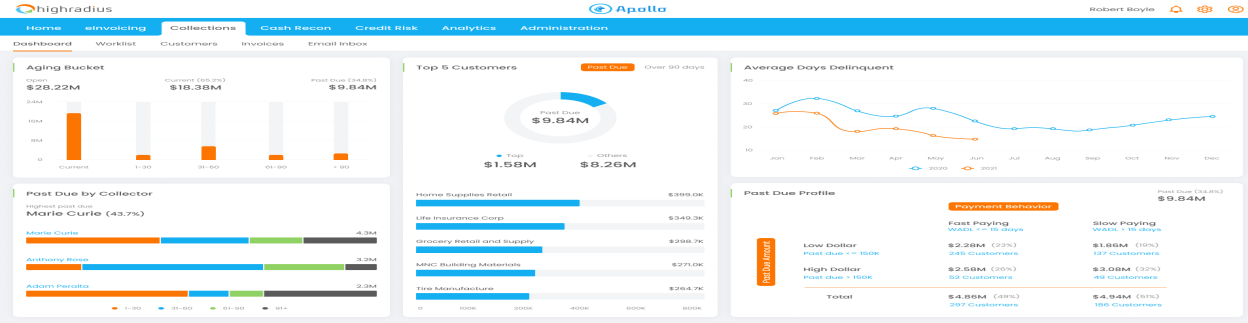
HighRadius doesn't sell you one product. It's a modular platform, and you license only the modules you pick. What you pay depends on which ones you choose and how many users you need, with transaction volume factored in on top.
The core AR modules are Collections, Cash Application, Credit, Deductions, and EIPP, which stands for Electronic Invoice Presentment and Payment. Each is priced separately, so a company licensing only Cash Application pays a very different rate from one running the full receivables suite.
Check what each one covers before you price them, because the module names don't always match how finance teams describe the work.
- Collections covers worklist prioritization and automated outreach
- Cash Application handles remittance matching and posting
- Credit runs scoring, limits and application workflows
- Deductions manages short pays and chargebacks
- EIPP is invoice delivery and the customer-facing payment portal
Teams discover mid-evaluation that a capability they assumed was included sits in a module they hadn't budgeted for. That's where quotes tend to jump.
Contracts typically run two to three years with pricing locked at the contract level. Annual billing is standard, so you're committing to a substantial spend before you've finished implementing. Adding seats mid-contract means reopening the negotiation.
What pushes the cost up
Five things decide where in that range you land.
- Modules licensed. Each module is a separate line item, and adding a second or third doesn't add a percentage. It can double or triple the subscription, because each one carries its own user fees and volume thresholds.
- User count. HighRadius prices by named user, so a mid-market company with five AR analysts pays far less than an enterprise running 40 across treasury and receivables.
- Transaction volume. Higher invoice and payment volumes push you into more expensive tiers, and companies processing millions of invoices a year pay considerably more.
- Integration complexity. Connecting to your ERP and banking systems adds professional services cost. The more systems and payment channels you run, the higher that bill gets.
- Contract length. Multi-year commitments buy a discount and cost you flexibility. Shorter terms carry higher per-year pricing.
Those five multiply each other. A three-module deal for a high-volume enterprise on SAP with 40 seats isn't three times the cost of a single-module deal for a small team. It's a different order of magnitude, which is why the two published averages sit so far apart.
Total cost of ownership beyond the subscription
The subscription is one part of what you'll spend.
Professional services are a separate bill. Configuration, data migration, custom workflows and training all sit outside the subscription, and enterprise customers end up with dedicated consultants for six to twelve months.
Your own team's time is the internal IT cost, and it never appears on the quote. ERP mapping, data validation, user setup and testing all come out of your headcount. The eight-month average implementation gives you a sense of how long that load runs.
Maintenance continues after go-live. Platform updates, integration monitoring and user training still need IT time, especially when your ERP environment changes.

Two numbers belong in the business case, eight months to implement and sixteen to a return, both from G2's user-reported data. On a three-year model, roughly the first half of year two passes before the platform has paid for itself. That assumes the rollout lands on schedule.
HighRadius's outcome-based pricing, explained
In February 2026, at its Radiance conference, HighRadius announced outcome-based pricing across its Office of the CFO software. It isn't limited to receivables, and it covers order-to-cash, accounts payable, record-to-report and treasury.
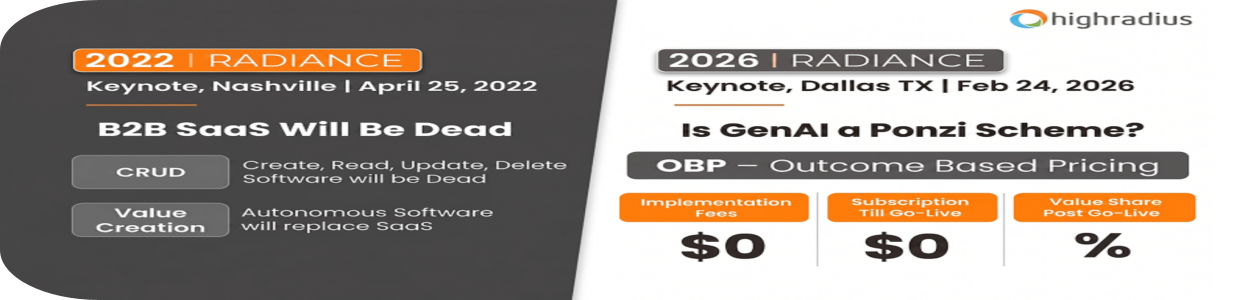
There are three parts to it:
- No implementation fees
- No subscription fee until go-live
- After that, HighRadius earns a fraction of the savings you realize, measured against P&L impact
Targets are agreed up front in a signed document HighRadius calls Mutually Agreed Success Criteria, or MASC. It carries baseline and target metrics, with a client executive signing off on completion.
The document carries weight. HighRadius arrived at the model through a 24-month controlled experiment comparing customers who had a MASC in place against those who didn't. It's the mechanism HighRadius itself uses to define whether a deal worked.
For buyers, this changes the shape of the risk without removing the cost. You're no longer writing a large check before go-live. You are agreeing up front to a set of metrics, and to a formula that decides what you owe later.
The questions that matter are how the baseline gets established, who arbitrates it if the two sides disagree, and whether the gain share is capped. The model doesn't change the timeline. The rollout takes as long as it always did.
How to negotiate a better HighRadius deal
If you're going ahead, a few things help before the quote lands.
The discount range is known. G2's user-reported data puts the average at 13%, so treat that as a floor rather than a ceiling.
Quarter-end and year-end are on your side. Enterprise software reps carry quotas tied to period close, and that pressure is free leverage for a buyer who isn't in a hurry. Ask when their fiscal year ends, then time the final round against it.
Fewer modules means a smaller year-one bill. Each module carries its own user fees and thresholds, so the cheapest way to control year-one cost is to license the one that solves your bottleneck. The trade-off is that adding modules later reopens pricing, without a competitive process running alongside it.
The term is negotiable too. Multi-year commitments buy a discount and cost you flexibility on a platform that takes months to implement. If you aren't certain about the fit, a shorter term at a worse rate can be the cheaper decision once you price in the risk.
If you're taking the outcome-based model, negotiate the MASC and not only the order form, because that's where the money is decided. Baseline metrics, target metrics, who measures them and who signs off all belong in there. So does what the gain share works out to in dollars, before anyone signs.
What happens at renewal
The first contract is the one you negotiate hardest, and it's the one where you have the most leverage. By renewal that leverage has moved. Your ERP mapping, your workflows and your team's training all sit inside the platform. The cost of leaving is the eight months you'd spend standing something else up.
Do two things at the first signature rather than the second. Ask for renewal caps written into the order form, so any uplift has a ceiling you agreed while you still had alternatives. Ask what happens to your data and your configuration if you leave, and get the export format in writing.
If you're on the outcome-based model, ask the same questions about the MASC. A gain share that renews against a new baseline is a different deal from one that renews against the original.
What users praise about HighRadius
HighRadius holds 4.3 out of 5 on G2 across 238 reviews, and a few strengths come up repeatedly.
Cash application is the module reviewers name most often as the strongest. One Capterra reviewer, a director of credit and collections, wrote:
"Having applied cash manually prior to implementation, I saved a lot of time and effort in the processing of receivables. Employees may take a day off, but Highradius never sleeps."
Breadth is the second strength. Companies that need collections, credit, deductions, cash application and EIPP in one place appreciate not stitching five tools together. As a corporate credit manager put it on Capterra:
"It is our credit application processor, cash posting tool, and collection assistant. With the aid of High Radius Integrated Receivables, we have been able to increase the speed of collections and positively impact cash flow."
Reporting rounds it out. Teams with large portfolios like the dashboards and forecasting, especially seeing aging, DSO trends and collector performance in one place.
What users complain about
The complaints are just as consistent.
Implementation is long and demanding. Setup needs dedicated time and formal training before the platform earns its keep. G2's comparison data backs that up, scoring HighRadius below lighter AR tools on ease of setup. One reviewer put it bluntly:
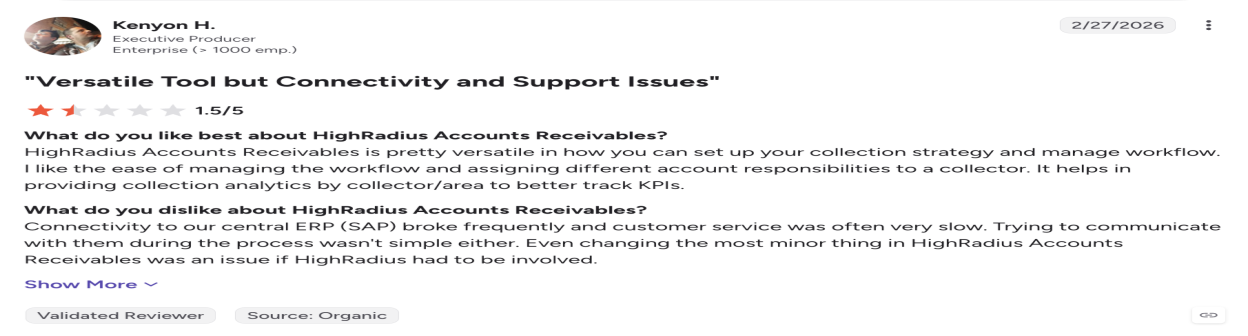
"One downside of HighRadius Accounts Receivables platform is that the implementation and customization can be quite complex, especially for large enterprises with multiple ERP systems and legacy workflows. It usually requires significant onboarding effort, process alignment, and training before teams fully adopt it."
The interface takes work to learn. The platform works. Getting your team fluent in it is the harder part, as another reviewer described:
"Despite its automation, the system can be complex to set up and master, especially for users not accustomed to advanced AR automation solutions. This often leads to a significant learning curve."
Customization hits limits. If your workflows don't match the out-of-the-box configuration, you'll meet what reviewers call rigid customization limits, and some report delays when support tickets need escalating.
That matters more if you're growing fast, because a platform that took months to configure isn't easy to reconfigure every time your workflow changes.
What the same job costs with Lunos
Lunos is an AI coworker for accounts receivable. There are no modules, no per-seat fees and no implementation fee. You're charged on what we collect, and only on the accounts you put Lunos in charge of, not your whole book. Our rates are published, so you can work the cost out before you speak to anyone, and you can start with one segment of the ledger on Monitor and widen from there.
| Your annual collections | Plan | What you pay |
|---|---|---|
| Up to $5M | Pay as you go | 0.3% of collections, so $15,000 at $5M. Maximum three users, single entity and ledger |
| $5M to $10M | Growth | $15,000 a year flat, unlimited users, NetSuite and Salesforce integrations, your own email domain |
| $10M to $1B+ | Enterprise | Custom, unlimited users, SSO, multiple ledgers, white-glove onboarding |
The two aren't measured the same way. HighRadius prices on modules and named users, and SpendHound's bands are drawn by employee count rather than collections, so there's no straight swap between the two.
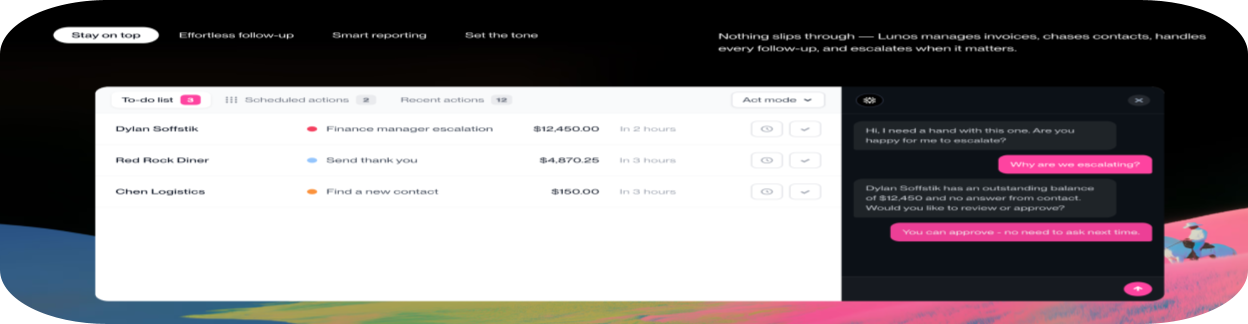
What you can compare is order of magnitude. A company with 50 to 1,000 employees pays HighRadius an average of $101,020 a year. A company collecting $10 million a year pays Lunos $15,000. Neither figure includes what your own team spends getting the thing live, and that gap is eight months against an afternoon.
One Lunos customer, John M Geehan of GEV Technologies, put the return in his own words:
"We've recovered payments from 2023-24 that we had almost written off."
You can put your own number in. There's an annual collections estimator on our pricing page that returns a figure without a form or a call.
You see the price before you talk to anyone
Our rates are on the site, the estimator is free to use, and you can sign up without a discovery call. No part of the cost depends on how well you negotiate.
We read what customers write back
HighRadius runs collections on cadences and worklists, and its AR inbox drafts replies to routine requests for a collector to approve. We read the reply and act on it.
When a customer writes "the check's going out Thursday", we log the commitment, note the date, and follow up on Monday if nothing arrives. When a customer flags a dispute, we route it to a human with the thread attached.
You decide how much the AI handles
There are three autonomy modes, and you set them per customer.
- Monitor watches and logs without acting, which is useful in the first few weeks while your team audits the behavior
- Suggest drafts the action, whether that's a reply, a follow-up cadence or a payment match, and queues it for approval
- Act executes on its own inside the guardrails you set, for high-volume work where queued exceptions slow the team down
HighRadius and Lunos at a glance
| HighRadius | Lunos | |
|---|---|---|
| Published pricing | None | Yes, with a cost estimator |
| Entry point | Custom quote after discovery | 0.3% on collections, self-serve sign-up |
| Pricing model | Modules plus named users, or gain share | Percentage of collections, or flat annual fee |
| Implementation fee | Separate historically, $0 under outcome-based pricing | None |
| Time to value | 8 months to implement, 16 to return (G2) | An afternoon to connect, results in the first month |
| Control model | Task agents, collector approves | Monitor, Suggest or Act, per customer |
| Security | Enterprise security suite | SOC 2 Type II attested |
FAQs
Is HighRadius worth the cost?
At enterprise scale, yes. Below that, rarely, because you're paying for modules you won't open. HighRadius fits large enterprises that need a full treasury and receivables platform with deep ERP integrations. If you're processing millions of invoices across multiple entities and can absorb a rollout measured in quarters, the breadth justifies the spend.
Who should look at alternatives?
Mid-market companies and growing teams under 50 users tend to find HighRadius more complex than their AR problem requires. If what you need is faster collections and fewer manual follow-ups, a lighter tool gets you there faster and cheaper. We've compared the field in our guide to HighRadius alternatives.
Does HighRadius offer a free trial?
There's no self-serve free trial. You go through a discovery call and a sales process. The outcome-based model lets you defer payment until the system's live, though that isn't a trial you can run on your own.
How long does HighRadius take to implement?
HighRadius quotes three to six months for a standard rollout, and G2 reviewers report an average of eight. Where you land depends on how many modules you're licensing and how complex your ERP setup is. The outcome-based model waives the upfront fee, but it doesn't speed the rollout up.
Can you use just one HighRadius module?
Yes. Modules are sold individually, so you can license Cash Application without Collections or Credit. Single-module deals still need implementation and ERP integration work, and adding modules later means a new pricing conversation.
What's the minimum HighRadius contract?
Two to three years is standard, with pricing locked for the term and billed annually. Shorter terms are possible and they carry a higher per-year rate, which is the trade you make for flexibility. Given the eight-month average implementation, a one-year term leaves you roughly four months of working product before renewal comes round.
What should you ask on the demo call?
Ask which modules are in the quote and which capabilities come attached to each. Ask what the named-user count covers and what a mid-contract seat addition costs. Ask for a written implementation timeline with named milestones, and ask what happens to the price if that timeline slips.
How does HighRadius pricing compare to other AR tools?
HighRadius is priced at the top end on both cost and scope, and the rest of the field is cheaper because it does less. The question that matters is whether you'll use the modules you're licensing, because an unused module costs the same as a used one. We've compared HighRadius with Billtrust and with Versapay head to head.
Start collecting faster with Lunos
HighRadius is built for enterprises that need a full receivables and treasury platform. For most buyers that means six figures a year and a rollout measured in quarters, so it isn't a fit for every team.
If you want to start collecting faster without the enterprise overhead, that's what we built Lunos for. We're SOC 2 Type II attested. QuickBooks, Xero and Sage Intacct connect from the first plan, NetSuite and Salesforce come with Growth, and HubSpot and Stripe run throughout, none of it a rip-and-replace.
You pay only when we help you collect. Get started for free, or book a demo if you'd rather see it on your own ledger first.
Make your receivables effortless and focus on what you do best