

Summarize:


Versapay vs HighRadius: which one fits your AR team?
Versapay and HighRadius both automate collections, but they're built for different buyers. Versapay is a collaborative AR portal where your customers log in to view invoices and pay. HighRadius is an enterprise order-to-cash suite whose AI agents sit inside the workflows, built to make human collectors faster. Neither publishes pricing, and both take months to roll out.

Janine Sullivan
19 October 2026

Quick summary
Versapay and HighRadius both automate collections, but they're built for different buyers. Versapay is a collaborative AR portal where your customers log in to view invoices and pay. HighRadius is an enterprise order-to-cash suite whose AI agents sit inside the workflows, built to make human collectors faster. Neither publishes pricing, and both take months to roll out.
| Tool | Key feature | Key limitation | Best for |
|---|---|---|---|
| Versapay | Shared portal where buyers self-serve on invoices and payments | Reporting and international payments have known gaps | Mid-market teams whose customers will use a portal |
| HighRadius | Full order-to-cash platform, with AI agents inside the workflows | Built to speed up human collectors, not replace them. Implementation runs three to six months | Large enterprises with dedicated IT |
| Lunos | An AI coworker that works receivables the way your best AR person would | No buyer portal, and a shorter ERP list than HighRadius | Mid-market AR teams collecting without adding headcount |
The sections below take Versapay and HighRadius one dimension at a time, starting with how your customers experience each one, then what they cost and how long they take to switch on. We've also written deeper breakdowns of each, covering Versapay alternatives and HighRadius alternatives.
Why listen to us
We built Lunos to fix the one part of AR that other tools leave alone. We're backed by General Catalyst and Cherry Ventures, with angel backing from current and former executives at GoCardless, Trustly and Typeform.

Every week we work with finance teams handling anywhere from 500 to 50,000 invoices a month. Those customers typically see a 10-60% reduction in overdue balances within the first month of full usage.
Versapay vs HighRadius: head to head
Both tools chase invoices for you, both connect to your ERP, and both report DSO and aging back to your team. The difference is where each one puts the work. Versapay moves it to a portal your customers log into. HighRadius moves it into an automation suite your finance team runs.
Buyer experience: Versapay gives your customers a portal, HighRadius doesn't
Versapay is a collaborative AR product. Your customers log into a shared workspace, see their invoices, pay them, and message your team in one thread. That replaces a lot of scattered email, and it's the clearest single reason to pick it.
Paying doesn't require the portal. An emailed invoice carries a payment link, and a customer can open it and pay once without ever setting a password. Setting one is what unlocks saved payment methods and AutoPay, and logging in is what unlocks the self-service and the shared thread.
The money arrives either way. Adoption decides whether you get the part you're paying for, because a customer who pays from the link and never logs in still emails your team to ask where their invoice is. Pilot it with real customers and measure how many enroll, not how many pay.
HighRadius has no equivalent buyer portal. Its model is outbound, with automated email, a parallel dialer and a virtual call attendant reaching customers directly.
Where Versapay's users hit friction
Versapay has three limitations to raise in a demo. Reporting struggles with complex custom views, so teams often export to a spreadsheet anyway, which undoes part of the point of having dashboards.
International payments are the second. You can invoice in a customer's local currency, though funds settle in USD or CAD, and reviewers report non-USD payments failing. A book with a meaningful share of overseas customers will meet friction there.
The third is account linking. Customers can link accounts themselves and the function can't be switched off, so people end up receiving notifications for accounts they have nothing to do with. Check payment ceilings too, because reviewers with large invoices report hitting a limit and having to take the payment another way.
None of this is fatal. On a single-currency domestic book with straightforward billing you may never meet any of it. On a complex one, these are the questions to ask before you sign.
Collections automation: templates and rules against 190+ AI agents
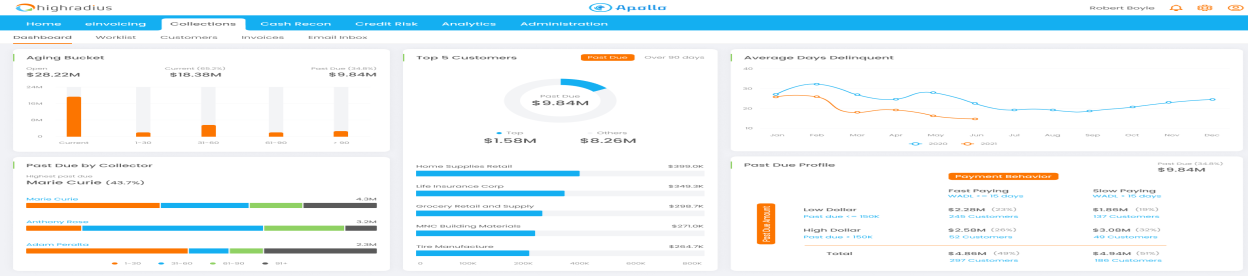
Versapay runs rule-based workflows and 100+ dunning notifications you configure per risk segment. Machine learning analyzes payment patterns, predicts payment timing and scores delinquency risk. That prediction data sits in the dashboards your collectors work from, so the worklist is ordered by who's likely to slip.
You build risk segments from scratch or start from presets, and customers move between them automatically as they meet the criteria. For a team that wants dunning to run on rules it sets, that's plenty.
HighRadius takes the same job and splits it across 190+ AI agents covering credit, collections, cash application and deductions. Worklist prioritization routes tasks on risk and payment probability, much as Versapay's does.
The difference is breadth against depth. HighRadius spans four functions where Versapay covers one, and that breadth is the reason enterprises buy it. Neither goes deep enough to finish a difficult account on its own. Versapay's analysis is decent, and it stops at handing a better-informed human the work. HighRadius reaches further into the task and still routes anything non-standard to a person.
Both share the same ceiling. Rules and task agents decide what to send next from the invoice's status, and the reply only changes the plan once a person has read it and changed it. A reminder fires because an invoice is 30 days late, whether or not that customer emailed last week to say the PO number was wrong.
Scope: HighRadius covers the whole order-to-cash cycle
HighRadius runs credit management, collections, cash application and deductions in one place. That's why it replaces several tools for a large finance team, and it's also why it's heavy for a small one. If you only want chasing handled, much of that suite is somebody else's job.
Versapay stays inside invoicing, payments and collections. If your AR needs sit there, the focus is a strength. If you also need deductions or credit workflows, you'll be adding another tool alongside it.
ERP integrations: 50+ for HighRadius, a handful for Versapay
HighRadius ships pre-built integrations with 50+ ERPs, and that's the practical reason enterprises pick it. If you're on SAP, Oracle or something less common, it's probably already covered.
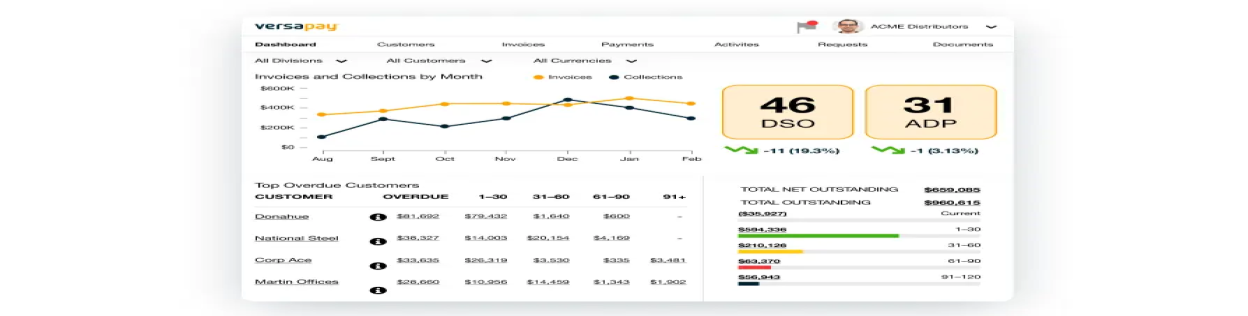
Versapay publishes native connectors for NetSuite, Sage Intacct and two Dynamics 365 products, and its G2 profile also lists SAP, Infor CloudSuites (M3) and MRI Property Management. Beyond those there's an open API and flat file import. That covers a lot of mid-market stacks, though it doesn't cover all of them, and a custom build against the API is a cost to price up front.
Pricing: neither one publishes a number
Neither vendor offers public pricing. Versapay is custom-quoted per contract. HighRadius moved to an outcome-based model in February 2026. There's no implementation fee and nothing to pay until go-live, and after that it takes a share of the savings you realize.
The model is easier on your cash flow, but it isn't transparency. You still can't compare the two on cost without running both sales processes, and the gain-share percentage is negotiated rather than published.
For contrast, Lunos publishes its rates in full, starting at 0.3% on collections. We've also broken down what HighRadius buyers report paying in a separate guide.
Implementation time: weeks for Versapay, months for HighRadius
Versapay's timeline depends on scope, and it runs from several weeks to a few months. G2 puts the average at four months from its reviewers. HighRadius quotes three to six months for a standard rollout, and G2's reviewers report eight months on average, with a further sixteen before they saw a return.
The gap costs more than the calendar suggests. You're still running the manual process throughout the rollout, so its cost includes everything it hasn't fixed yet.
Reviews: HighRadius 4.3, Versapay 4.1
HighRadius Accounts Receivables scores 4.3 out of 5 from 238 reviews on G2. Versapay scores 4.1 from 101. Both are solid, and the gap is too small to decide anything on its own.
HighRadius was named a Customers' Choice in Gartner's 2025 Voice of the Customer for Invoice-to-Cash Applications. It's been a Challenger in the Gartner Magic Quadrant for Financial Close and Consolidation Solutions in both 2025 and 2026. That recognition carries weight in enterprise procurement, which matters if you need to justify the choice internally.
Handling customer replies: standard requests only
Both products are good at getting a message out. Versapay posts it to the portal and emails a notification. HighRadius emails, dials and leaves voicemails, and its virtual call attendant answers inbound calls around the clock. Then the customer answers, and what happens next is where they separate.
Versapay's portal gives that conversation somewhere tidy to live, and it beats a shared inbox. It's still your team reading every message and deciding what to do about it.
HighRadius goes further. Its AR email inbox identifies the customer from the email, sorts collections messages from the rest, assigns them to a collector, summarizes long threads and drafts a reply with the invoice copy or statement attached. HighRadius classifies it as an assisted agent, which means a person approves what goes out.
That covers the standard requests, the invoice copies, the statements, the "we're paying on the 30th". The rest still lands on a human. A short payment with a reason attached, a disputed line, a customer whose promise slipped twice, an account that needs a judgment call about escalating. Those are the ones that take the time, and neither product resolves them.
It helps to put a number on it. If you send 2,000 invoices a month and 5% of them draw a reply, that's 100 messages coming back. Drafting the routine ones saves real minutes. The handful that need a decision still need yours, and automating the sending raises the total, because more reminders going out means more replies coming back.
Versapay vs HighRadius: which should you choose?
Pick Versapay if
Your customers will use a portal, and the questions eating your week are invoice copies, payment status and remittance queries. A shared workspace answers those without your team touching them. Pilot it with a handful of your customers first, because the portal only pays off if they log in.
Pick HighRadius if
You're a large enterprise running credit, deductions and cash application at volume. You've got a dedicated IT team, and a three to six month rollout is acceptable. The breadth is the whole point, and at that size you'll use enough of it to justify the cost.
Both of those answers assume the problem is getting messages out. There's a third case, where that part already works.
Pick Lunos if
Your invoices go out fine and your customers do reply. They reply to a human, and that human is on your team spending hours a week reading, deciding and following up. Or your team only has time for the top accounts, and the long tail sits in aging buckets. Both are the job we built Lunos to do, working every account and every reply rather than the ones a person can get to.
The best Versapay and HighRadius alternative: Lunos
Best for: mid-market AR teams that want the replies handled as well as the chasing.
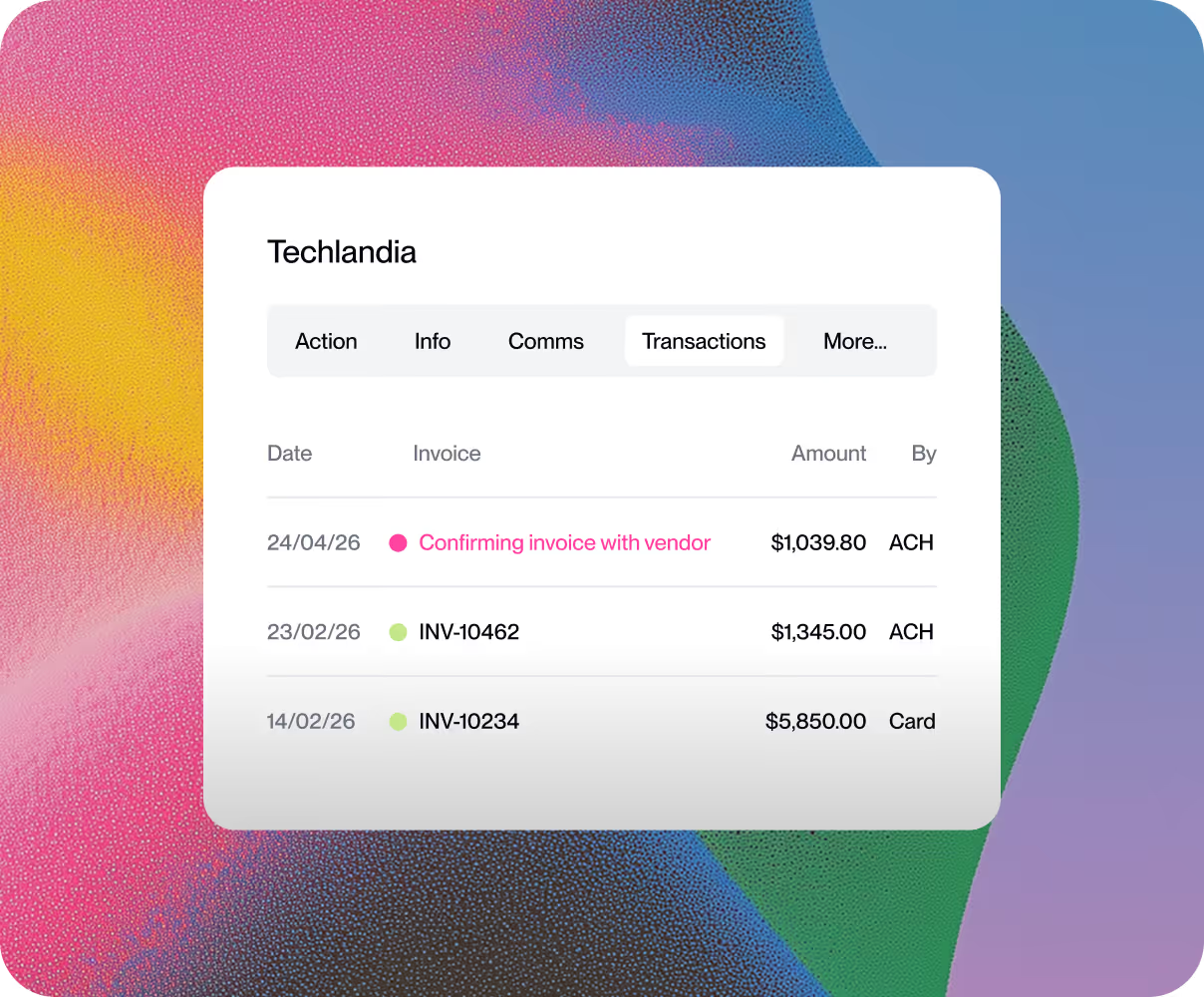
We build a separate agent for each stage of the receivables cycle. They work from the same customer context, so nothing gets dropped in a handoff between them.
- Collections agent: runs the follow-up cycle, reads what customers write back, logs promises to pay, and escalates when an account goes quiet
- Cash application and reconciliation: matches incoming payments to open invoices, including partial payments and payments that arrive with no remittance advice
- Dispute management: spots a disputed invoice in the thread, categorizes it, and routes it to the right person with the history attached
- AP portal uploads: submits your invoices into your customers' procurement portals so your team isn't rekeying them by hand
Those agents share one set of connections. Your ERP and billing integrations, payment providers, comms channels and reporting get set up once, and every agent uses them.
That is the main difference between us and the other two. Versapay automates notifications and gives buyers a portal. HighRadius runs 190+ task-specific agents across order-to-cash. We use a small number of agents that reason on the whole customer account instead of working invoice by invoice.
Our collections agent holds a two-way conversation. When someone writes back "we'll pay next Friday", we log the promise and schedule the follow-up for that day. When someone writes "this invoice is wrong", the dispute agent picks it up and routes it to your team with the history attached.
You decide how much autonomy it gets. Monitor watches your inbox and surfaces what matters, Suggest drafts the responses and waits for your approval, and Act handles the conversation end to end. You set it per customer, so your largest accounts can stay on Suggest while routine collections run on Act.
Getting going takes an afternoon, not months. You connect your ERP, set your autonomy preferences, and we start working your open invoices. We integrate with NetSuite, QuickBooks Online, Xero, Sage Intacct and Microsoft Dynamics 365, with Salesforce and HubSpot, with Stripe, GoCardless and ACH bank feeds, and with AP portals including Ariba, Coupa, AvidXchange, Ramp, Tipalti and Tradeshift.
Pricing structure
Our pricing is published, so you know the cost before your first call with us.
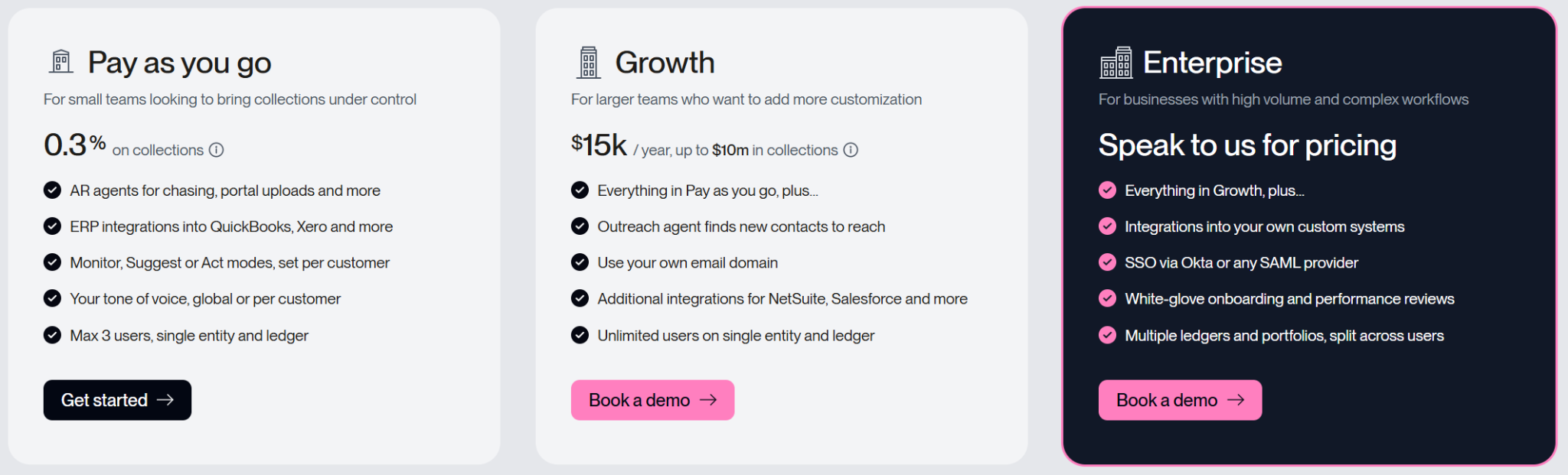
- Pay as you go: 0.3% on collections, charged only on the accounts you put Lunos in charge of, up to $5M in annual collections, maximum three users
- Growth: $15,000 a year for $5M to $10M in collections, unlimited users
- Enterprise: custom pricing for $10M to $1B+ in collections, unlimited users and white-glove onboarding
Where we're still behind
We're early-stage, so our customer base and track record are smaller than either alternative. If market validation carries weight in your procurement process, that's a fair thing to hold against us. What we can put in front of procurement today is SOC 2 Type II attestation and a public trust center, which covers most of what a security review asks for.
We don't have a buyer portal. Your customers deal with us over email and payment links rather than logging into a dashboard. If portal self-service is what you're buying, Versapay does it and we don't.
Our integration list is shorter than HighRadius's 50+ ERPs, though we cover the main mid-market ledgers. AI phone calls, letters and text messages aren't live yet either.
Versapay vs HighRadius vs Lunos: feature comparison
| Feature | Versapay | HighRadius | Lunos |
|---|---|---|---|
| AI-powered collections | Rule-based automation with AI/ML prediction | 190+ task-specific AI agents | Two-way conversational AI with intent understanding |
| Dunning automation | 100+ notifications, rule-based triggers | Automated email and parallel dialer | Adaptive follow-ups based on customer replies |
| Reply handling | Human, inside the portal thread | AI drafts replies to standard requests, collector approves | Resolves the reply and reschedules the follow-up, autonomous on Act |
| Buyer portal | Yes, collaborative workspace | No dedicated portal | No portal (email and payment link based) |
| Promise tracking | Collectors record promised dates by hand | Collectors log promises in the workspace | Captured automatically from the customer's reply |
| Autonomy control | Configurable rules | AI-driven task routing | Monitor / Suggest / Act per customer |
| ERP integrations | NetSuite, Sage Intacct, Dynamics 365, SAP, Infor | 50+ ERPs | NetSuite, QuickBooks Online, Xero, Sage Intacct, Dynamics 365 |
| Implementation time | Weeks to months, 4 on average | 3-6 months quoted, 8 reported | An afternoon |
| Public pricing | No | No | Yes, from 0.3% on collections |
| G2 rating | 4.1 from 101 reviews | 4.3 from 238 reviews | 4.8 from 3 reviews |
| Security compliance | SOC certified | Enterprise security suite | SOC 2 Type II |
FAQs
Can Versapay and HighRadius handle two-way customer conversations?
Versapay lets buyers and sellers message each other through its portal, and those conversations are human-driven on both sides. HighRadius automates email outreach and has a virtual call attendant, though its agents each handle a specific task. HighRadius does read inbound email, sorting it, summarizing it and drafting a reply for standard requests, with a collector approving what goes out. What neither one does is resolve a non-standard reply and change the follow-up plan without a person in the middle.
How long does implementation take for each platform?
Versapay's timeline depends on scope and usually runs from several weeks to a few months. HighRadius is the longest, at three to six months for a standard deployment and longer for complex enterprise setups. Lunos goes live in an afternoon. You connect your ERP, set your autonomy preferences, and the AI starts working your open invoices.
Which one is best for mid-market AR teams?
HighRadius is built for large enterprises with dedicated IT and the budget for a multi-month rollout. Versapay works from mid-market up, though you'll still need a custom contract and your customers will need to adopt the portal. If you want AR automation running fast with pricing you can see, that's what we built our AR agents for.
Do any of these platforms publish their pricing?
Only Lunos. Pay as you go starts at 0.3% on collections, Growth is $15,000 a year, and Enterprise is custom-quoted. Versapay quotes per contract and HighRadius negotiates a gain-share percentage, so both require a sales process before you see a number.
What happens to my customers if I switch AR tools?
That depends on how they pay you today. Moving off a portal-based tool is the disruptive case. Your customers have logins, saved payment methods and a habit built around it, so plan a communications window for them. Moving off an email-based tool is close to invisible, because the invoices keep arriving the same way.
On your side, the work is in the data. You're migrating open invoices, contacts, payment history and your collection rules, and the effort scales with how much you customized the old setup.
Pick the AR tool that fits how your team works
If your priority is giving buyers a self-service portal for invoices and payments, Versapay is the one of the three that does it. If you're a large enterprise that needs a full order-to-cash suite and you've got the IT team and budget for it, HighRadius is the market leader.
If the thing costing you hours is reading what customers send back and deciding what to do about it, that's the job we built Lunos for. You can connect your ledger, leave every account on Monitor, and watch what it would have done before you hand it anything.
Start for free and you'll know exactly what you're paying from day one.
Make your receivables effortless and focus on what you do best