

Summarize:


10 Best Upflow Alternatives for B2B Finance Teams in 2026

Janine Sullivan
01 June 2026

Quick Summary
Upflow users often complain about payment handling, limited flexibility, and unprofessionalism. The best AR tools make life easier for your team without forcing you to compromise on features and customer satisfaction. In this guide, we break down 10 reliable alternatives to Upflow in 2026.
Here are our top picks:
Looking for the Best Upflow Alternatives for Your Team?
Upflow is a solid AR tool.
It centralizes invoices, sends reminders, and gives SaaS finance teams a cleaner view of their receivables than a spreadsheet ever will. Plenty of teams have used it to get out of inbox chaos and into a real collections process.
The problem comes when you push it. Reporting flexibility runs out faster than most finance teams expect, partial payments need awkward workarounds in the underlying accounting system, and the AI it offers is template automation rather than something that adapts.
The tools below fix those gaps in different ways, and one of them will fit your team better than Upflow does.
Why Listen to Us?
Lunos is built specifically for AR. We've worked with finance teams handling anywhere from 500 to 50,000 invoices per month and are proud to be backed by GoCardless, General Catalyst, and other partners.

Our founding team has over 50 combined years of fintech experience. We work with B2B finance teams every day to replace spreadsheets and inbox triage with an AI coworker that handles the repetitive parts of collections.
That experience shapes how we evaluate the rest of the market.
Why Look for Upflow Alternatives?
Upflow is a solid AR option, but the same review pages surface a consistent set of complaints that finance teams should consider before signing on.
Reporting and Dashboard Flexibility Is Limited
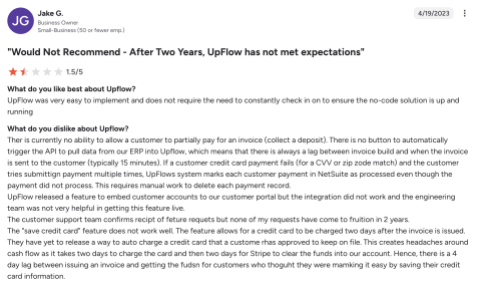
Multiple G2 reviewers describe Upflow's reporting and filtering as rigid. Upflow’s dashboard offers limited ways to slice data, restricting user flexibility and the service’s functionality. For finance teams that need nuanced AR data, this becomes a real ceiling.
Payment Handling Has Gaps
Upflow doesn't natively support partial payments on invoices. A G2 reviewer flagged this as a "major concern" given how often B2B customers pay in installments. Overpayment displays have also been called out as awkward, and reviewers report that some invoice and payment scenarios require manual workarounds in the underlying accounting system.
Reminder Emails Can Look Unprofessional
Because Upflow sends reminders from a reminders@upflow.io address, customers regularly treat them as spam. A G2 reviewer went one step further, calling the email design "a tad bit scammy" because of how the payment link is presented. For finance teams that care about brand and customer relationships, this matters.
ERP and Data Sync Issues
Several reviewers mention that integrated contacts and addresses can't be modified or deleted from inside Upflow. Others note that some invoices don't appear unless they're recorded manually. Native integrations with SAP and Oracle aren't available, so enterprise teams end up with external workarounds. These small friction points add up at scale.
Our List of the Top 10 Upflow Alternatives
1. Lunos
Best For: B2B SaaS and other recurring-revenue finance teams that want to scale collections without adding headcount.
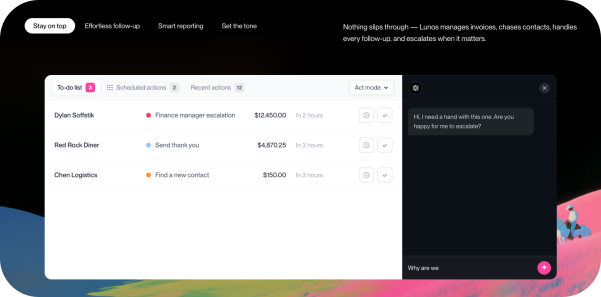
As an industry-leading AI coworker, Lunos earns its spot at the top of our list of Upflow alternatives. Where most tools automate reminders and stop there, Lunos understands customer promises, manages two-way conversations, and provides a distinct human element that customers are drawn to.
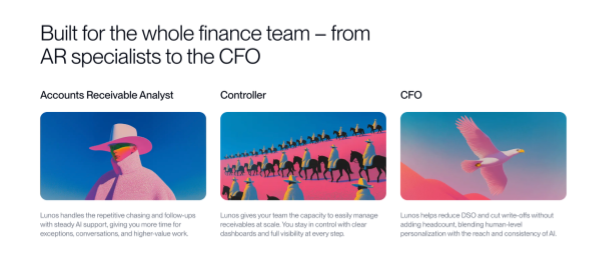
Lunos runs the parts of collections that used to need a human, operating with true conversational intelligence while leaving the strategy and exceptions to your finance team. This means freeing your team up for the important tasks without sacrificing quality.
Key Features
- AI-powered customer conversations that read inbound emails, understand intent, and respond in your tone
- Adaptive follow-ups that adjust timing and tone based on relationship history and payment behavior
- Slack-native workflow for approvals, daily summaries, and team collaboration
- Three autonomy modes (Monitor, Suggest, Act) so teams control how much independence the AI has
- Native integrations with NetSuite, QuickBooks, Xero, Stripe, HubSpot, and Salesforce
- Automatic exception routing for disputes and complex situations that need human attention
- Complete audit trail of every outreach, response, and promise
Pricing
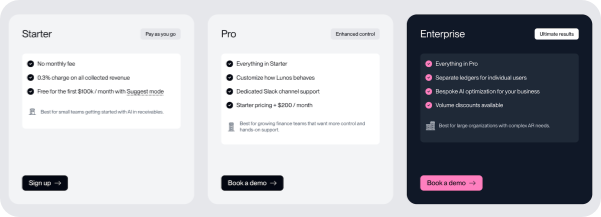
Lunos offers a free start option and custom pricing based on your business's volume and usage.
- Starter: $0/month (0.3% fee on collected revenue)
- Pro: $200/month + 0.3% fee
- Enterprise: Custom pricing
Request a demo to get pricing tailored to your setup.
Pros
- Handles two-way conversations, not just outbound sends, which most "AI" AR tools still don't do
- Slack-first workflow means finance teams stay in their existing tools
- Monitor / Suggest / Act modes let teams ease into AI autonomy at their own pace
- Customers report meaningful DSO reductions and around 75% lower AR workload within the pilot
Cons
- Newer to market than legacy AR platforms, so the G2 footprint is still building
- The full AI coworker model is a shift in mindset for teams used to template-based reminder tools
- Best suited to B2B teams with reasonable invoice volume (not micro-businesses)
2. Chaser
Best For: Mid-market firms that want reminder automation without losing the look and feel of a professional outreach.
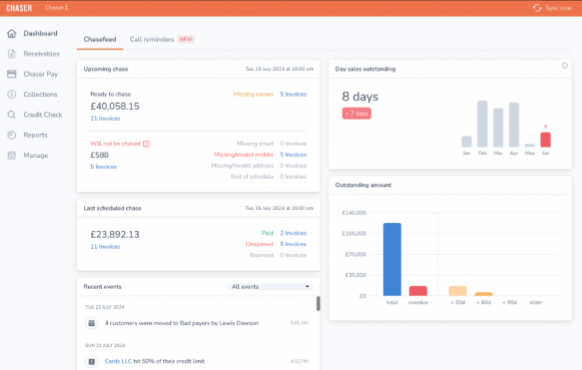
Chaser is a UK-founded AR automation platform that's been doing credit control well for over a decade. It focuses on multi-channel reminders and deep CRM logging.
Key Features
- Automated reminders by email and SMS
- AI-drafted replies in your tone of voice
- Centralized communication timeline pulling in replies, call notes, and tasks
- One-click escalation to debt collection services
Pricing
Chaser offers tiered subscription plans starting at $240 and scaling up to an enterprise tier.
Pros
- Reminders go out from your own email address with your signature and branding
- Strong native integrations with Xero, QuickBooks, Sage, and NetSuite
- AI reply drafts save significant time on customer correspondence
- A multi-channel approach (email, SMS, phone) covers more ground than email-only tools
Cons
- Reporting flexibility is limited, with reviewers asking for more bespoke options
- Payment plan structures are rigid, locked to 1, 2, or 4-week cadences
- The Collections add-on is often called out as expensive
- Email automation issues are a recurring theme in G2 negative summaries
G2 Rating: 4.4
3. Tesorio
Best For: Mid-market and enterprise finance teams where cash forecasting is as important as collections execution.
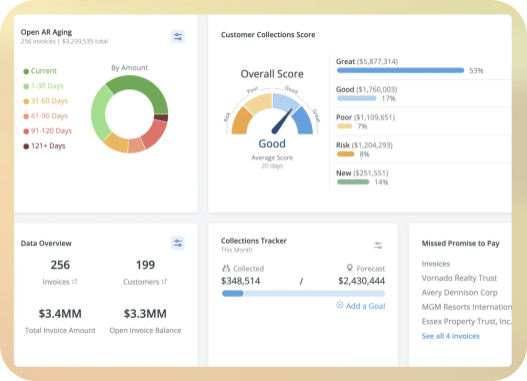
Tesorio is a cash flow performance platform that uses AI and machine learning to predict when payments will arrive and to automate collections workflows. It's used by enterprise teams like Slack, Box, and Twilio.
Key Features
- AI-powered payment prediction
- Cash flow forecasting with real-time updates
- Automated collections workflows and worklist prioritization
- ERP integrations with NetSuite, QuickBooks, and Salesforce
Pricing
Custom pricing. Plans are sold in fixed packages rather than à la carte.
Pros
- Predictive analytics gives finance teams advanced warning on at-risk payments
- Strong real-time visibility across the AR portfolio
- Pre-populated email templates save time on collector communications
Cons
- ERP sync delays are mentioned by multiple G2 reviewers
- Fixed packaging limits customization for smaller teams
- Occasional system downtime reported (rare but noted)
G2 Rating: 4.7
4. Versapay
Best For: B2B companies with high dispute volume and customers who want self-service AR visibility.
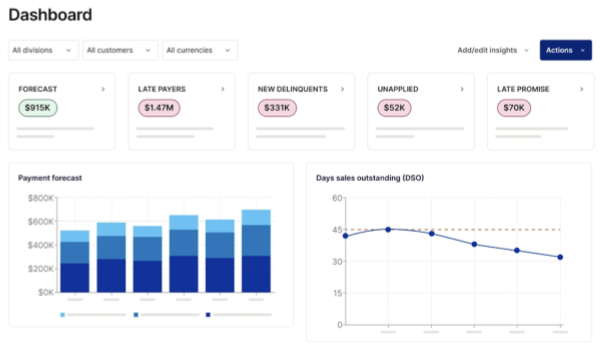
Versapay coined the term "Collaborative AR." Its product is built around a shared portal where buyers and sellers see the same invoices, disputes, and payment statuses in one workspace.
Key Features
- Customer-facing AR portal
- Collaborative dispute resolution in real-time
- Virtual card acceptance and multi-channel payments
- Deep NetSuite integration
Pricing
Custom pricing. Subscription tiers based on features and user count.
Pros
- The collaborative portal reduces back-and-forth on disputes
- NetSuite integration is widely praised
- Significant past-due invoice reduction reported (around 30% in case studies)
- 80% customer adoption rate is among the highest in the category
Cons
- ERP integrations outside NetSuite can be tricky and slow
- Customer support response times occasionally stretch to two weeks for non-urgent issues
- Reporting and analytics aren't as robust as some competitors
- Initial setup has a learning curve
G2 Rating: 4.1
5. HighRadius
Best For: Large enterprises with complex multi-entity AR.
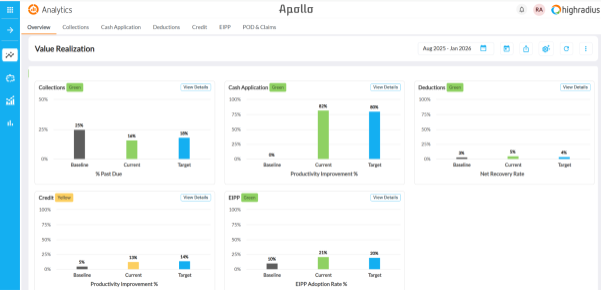
HighRadius is an enterprise-grade autonomous finance platform. Its AR suite covers cash application, collections, deductions, and credit, with 186 AI agents handling significant portions of the work autonomously.
Key Features
- Autonomous cash application with 90%+ match rates
- Prioritized collections worklists
- Automated deductions and dispute systems
- Credit risk scoring and limit recommendations
Pricing
Custom pricing
Pros
- Powerful AI for cash application matching
- Full enterprise AR stack in one platform
- Strong deductions and disputes module
- Robust reporting for finance leadership
Cons
- Batch processing instead of real-time sync
- Email inbox requires manual monitoring to associate replies
- 6+ month enhancement timelines flagged by reviewers
- Enterprise pricing and implementation timelines aren't realistic for most mid-market teams
G2 Rating: 4.3
6. Growfin
Best For: Mid-market B2B SaaS teams with Salesforce-centric workflows.
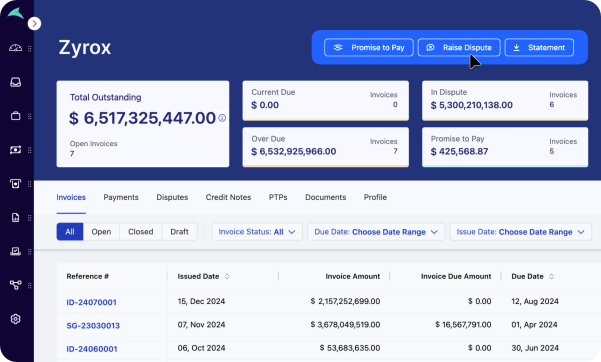
Growfin describes itself as a Finance CRM. It's built specifically for B2B teams that want to embed AR data inside Salesforce and run collaborative collections through Slack.
Key Features
- AI agents for prioritized follow-ups
- Dedicated Salesforce instance for sales and CS team access to AR data
- Custom reporting and DSO/ADP forecasting
- Dispute tracking via tickets
Pricing
Custom pricing.
Pros
- Deep Salesforce integration
- Slack-first collaboration on disputes and promise-to-pay
- AI insights into payment risks are useful for prioritization
- Helpful onboarding and customer support during setup
Cons
- ERP sync delays of 20 minutes or more have been flagged
- No US-based support or sales hours
- Some features still feel early in their development
- Data sync from Zoho and SAP can be slow
G2 Rating: 4.5
7. Invoiced
Best For: SMBs and growing companies with subscription or recurring revenue models.
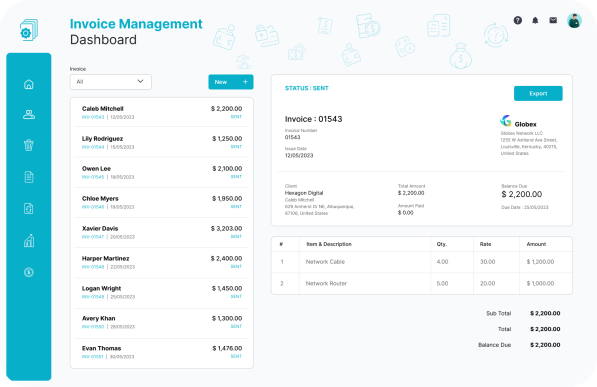
Invoiced is an AR automation platform aimed at SMBs and growing mid-market companies. Its biggest strength is billing flexibility for subscription and usage-based revenue models.
Key Features
- Smart Chasing follow-up sequences
- Subscription and recurring billing with proration and trial handling
- Multiple payment methods (ACH, credit card, wire)
- Cash application and reporting
Pricing
Tiered, with a free plan available. Enterprise plans are custom-quoted.
Pros
- Most flexible billing engine we’ve looked into
- Strong subscription billing capabilities
- Clean, professional invoice templates
- Free tier makes it easy to evaluate
Cons
- Post-Flywire acquisition, pricing transparency has been flagged in recent G2 reviews
- Support quality reportedly slipped after the acquisition
- Reactivation processes have had reported failures
- Less suited to enterprise complexity
G2 Rating: 4.5
8. Gaviti
Best For: Mid-market companies that want structured collections workflows
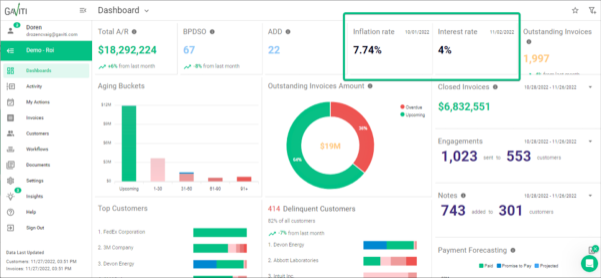
Gaviti is an AI-powered invoice-to-cash platform that combines collections workflows with built-in B2B payment acceptance. It's ERP-agnostic, which is rare in the category.
Key Features
- Structured collections workflows with task management
- Built-in B2B payment portal with zero-fee ACH
- Credit risk tools
- ERP-agnostic integrations (including homegrown systems)
Pricing
Custom pricing
Pros
- Clear visibility into aging, follow-ups, and disputes in one place
- Quick implementation compared to enterprise platforms
- Zero-fee ACH payment portal included in every plan
- ERP-agnostic, so it works with niche or custom systems
Cons
- Slow performance during peak usage
- Customization options are limited
- Reporting is called out as inadequate on G2
G2 Rating: 4.7
9. Billtrust
Best For: Mid-market to enterprise B2B businesses with diverse customer invoice delivery requirements.
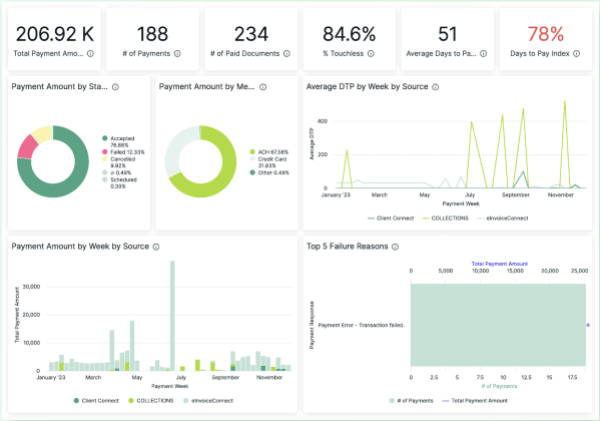
Billtrust is one of the longest-established players in AR automation. Its standout function is invoice delivery across every channel B2B customers actually use, including paper, email, EDI, and customer portals.
Related: See how Billtrust and HighRadius compare.
Key Features
- Multi-channel invoice delivery (paper, email, EDI, customer portals)
- Business Payments Network
- AI cash application with high straight-through processing rates
- Credit management tools
Pricing
Custom pricing. Subscription-based with tiered plans.
Pros
- Industry-leading invoice delivery
- Strong cash application matching
- Robust B2B payments network with real network effects
- Trusted by enterprise B2B teams
Cons
- User interface feels dated compared to newer entrants
- Invoicing issues with delayed updates and incorrect partial payment displays
- Payment issues, including delayed transfers
- Email automation issues are a recurring complaint
G2 Rating: 4.4
10. Quadient AR (YayPay)
Best For: Mid-market companies that want predictive AR analytics with a clean, easy-to-adopt interface.
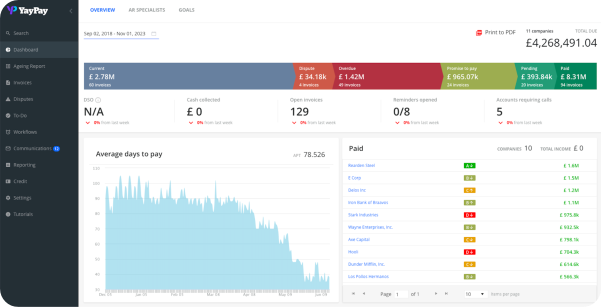
Quadient AR, formerly YayPay, is a predictive AR automation platform with ML-driven cash forecasting and a polished customer portal. It's backed by Quadient's enterprise reach.
Key Features
- Automated dunning workflows
- Promise-to-pay tracking
- ML-based cash forecasting
- Secure customer self-service payment portal
Pricing
Custom pricing.
Pros
- Clean, intuitive UI with a low learning curve
- Smooth NetSuite integration
- Effective dunning automation
- Helpful onboarding process
Cons
- Customer support responsiveness is inconsistent
- Doesn't send payment receipts automatically
- Payment issues mentioned in some G2 reviews
- Software updates have removed some previously-loved features
G2 Rating: 4.4
How to Choose the Right Upflow Alternative?
Four things worth checking before you commit:
1. Two-way intelligence.
Most tools automate outbound sends. Only a few understand and adapt to fit the situation. If you're spending hours every week triaging payment promises and disputes in your inbox, AI-forward tools like Lunos can help your team free up valuable time.
2. Email branding and deliverability.
If reminders go out from a third-party domain, customers often flag them as spam, leading to misunderstandings that can hurt your relationships. Tools that send from your domain with your branding (Lunos, Chaser) preserve professionalism.
3. ERP and billing integration depth.
"Native integration" can mean many different things. Ask specifically about sync frequency, whether all invoice types appear automatically, and whether contacts and addresses can be edited inside the tool. Tools that sync in real time and let you manage records in one place save hours of cleanup.
4. Where humans stay in the loop.
Full autonomy isn't always right. The best tools let you decide what the AI handles independently versus what it surfaces for review. Lunos's Monitor, Suggest, and Act modes are the clearest example of this in the market.
FAQs
What's the difference between AR automation and an AI AR coworker?
AR automation sends scheduled reminders and shows you dashboards. An AI coworker reads customer replies, understands what they mean, and adapts based on what works.
How long does it take to implement a new AR tool?
It varies widely. Tools like Lunos, Chaser, and Invoiced typically go live in days to weeks. Enterprise platforms like HighRadius and Billtrust can take 3-6 months or longer.
Can I switch from Upflow without disrupting collections?
Yes, if you plan the transition carefully. Most alternatives support data import and parallel running. The cleanest cutover is usually at a month or quarter boundary.
Modernize Your AR Processes With Lunos
Upflow does the basics well and has earned its loyal user base. But the AR category has moved fast in the last two years, and the gap between automating reminders and actually running collections with AI is wider than it used to be.
Lunos was built to fill this gap. With a two-way intelligence that reads replies, tracks promises, adapts follow-ups, and cash flows smoothly without manual effort. Customers report around 75% lower AR workload and meaningful DSO reductions within the pilot period.
Request a demo today to see how Lunos can save your team time and money.
Make your receivables effortless and focus on what you do best